Why the Mould Costs More Than the First Batch of Figures
The mould can cost more than the first batch of figures. Why tooling is priced once, what drives the fee up, and the six questions to ask before you approve it.
Why the Mould Costs More Than the First Batch of Figures
The first quotation is where most first-time creators get their first shock. Not the unit price — the tooling line. A single line item, the mould, can cost more than the entire first batch of figures it is supposed to produce, and the natural reaction is to assume the quote is padded.
It is usually neither. Tooling looks expensive because it is a different kind of cost from everything else on the quotation. The figures are priced per piece. The mould is priced once, for the whole project, and it has to be paid before a single saleable piece exists.
Factory cost guides return to this question again and again — EDNTOY, Demeng Toy, PrintAWorld and Amoy Figures all publish breakdowns that start from the same confusion. Collectors notice it from the other side, too: in a Statue Forum thread about a Swamp Thing maquette, buyers debated why a PVC version carried a higher retail price, and the answer kept coming back to tooling.
What tooling actually is
Tooling is not material, and it is not a part of the figure. It is the engineering that turns a design into something a factory can repeat.
A sculpt exists once. A mould exists so that the same shape can be produced hundreds or thousands of times, by people who did not sculpt it. Building that repeatability is skilled work: the design is reviewed for release, split into parts that can come out of a mould cleanly, and given draft angles and parting lines. It also needs its supporting cast — master models, jigs and fixtures that hold parts in position for painting and assembly.
None of that shows up in the finished figure, and a buyer will never see the mould, the master or the fixture. But without them there is no second piece, and no thousandth piece that matches the first. When a quotation lists tooling as a separate line, it is charging for the ability to manufacture, not for the material in the box.
Silicone, steel, and iron: three mould families, three cost shapes
There is no single thing called "a mould". Three families cover most collectible production, and each has a different cost shape. Choosing the wrong family means choosing the wrong cost structure — one of the most expensive mistakes a first project can make.
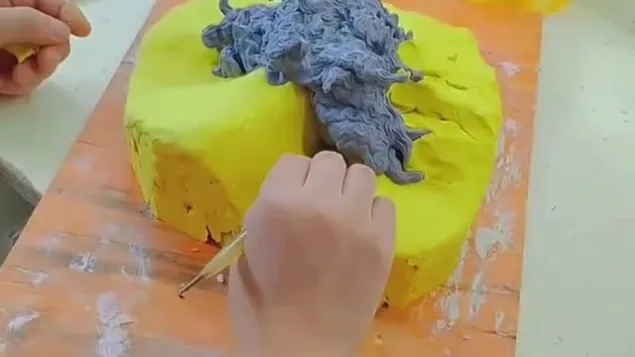
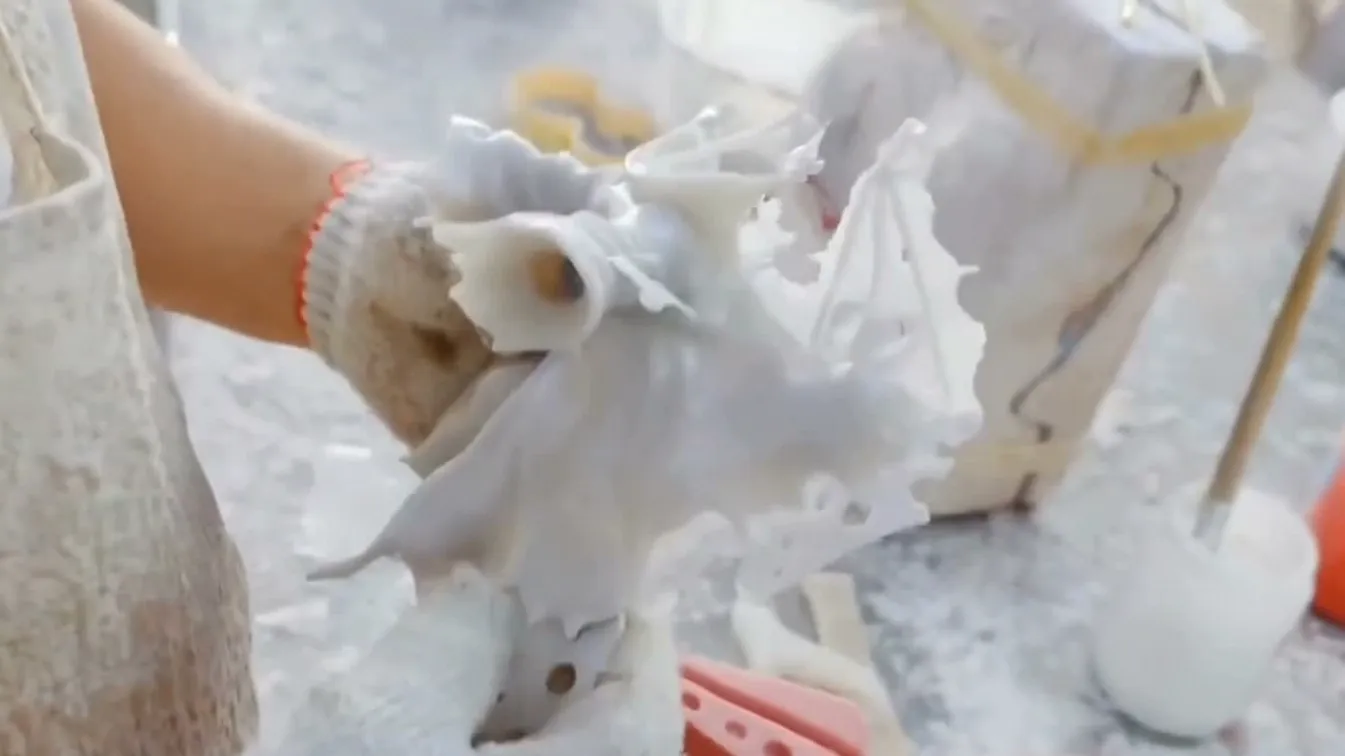
Silicone moulds are the workhorse of resin casting. They are made by pouring liquid silicone around a master model, so they capture fine detail well, and they are flexible — parts with undercuts and complex shapes can be pulled out without breaking. The upfront cost is comparatively low, which is why resin is the usual route for small runs and highly detailed statues. The trade-off is lifespan: silicone is a consumable, not a permanent tool. It softens, tears and loses detail with use, and at Mancheng a silicone mould is treated as having a working life of about a year, so a large run may need re-moulding partway through — a cost to plan, not discover.
Steel moulds are the tooling of injection moulding for PVC and ABS. Machined from blocks of steel, they are expensive to cut and very long-lived once they exist. A steel mould can run large volumes at a low cost per piece, which is why PVC and ABS make sense at scale. But the upfront investment is heavy, and changes after cutting are difficult and costly. Iron moulds, used in rotational moulding, sit in between, suited to larger, hollow pieces.
The practical point is simple. Silicone is cheap to start and expensive to repeat. Steel is expensive to start and cheap to repeat. A project that picks steel for a small run will be crushed by the upfront cost; a project that picks silicone for a large run will be worn down by re-moulding. At Mancheng, resin silicone moulds carry no separate charge, while PVC tooling and injection moulding are managed through a partner.
What drives the fee up
If two projects look similar in size and still receive very different tooling quotes, the difference is almost always in the geometry. Four factors move the fee more than anything else.
Part count comes first. Every separate part needs its own mould cavity, its own release path, and its own handling. A figure split into twenty parts needs far more tooling than the same figure split into eight, even though the finished product looks the same on a shelf. This is why part-break planning matters before tooling starts, as explained in How to Plan Part Breaks Before Tooling a Collectible.
Undercuts come second. Any feature that stops the mould from opening in a straight line — a clip, a side hole, a groove, a hooked shape — needs a mechanism to release it: a slider, a lifter, or an insert. Each mechanism is extra machining and extra time — the subject of "Undercuts: The Detail That Quietly Doubles Your Tooling Cost". Silicone moulds absorb undercuts more gracefully, because the flexible material peels away; steel moulds cannot, and every undercut is priced as a mechanism.
Size comes third, and detail density fourth. A larger figure needs a larger mould, more material, and a bigger machine — and machining cost grows faster than size. Fine textures, sharp edges and deep recesses take machining time and careful finishing, while a smooth, simple form cuts quickly.
None of these is a surcharge — it is the work itself.
The amortisation logic
The idea that makes tooling feel fair is amortisation, and it is simple arithmetic, not a pricing trick.
Tooling is a fixed cost — the same for one hundred pieces or one thousand. The unit price is a variable cost, paid once per piece. The cost of each figure is the variable cost plus its share of the fixed cost — and the share depends entirely on how many pieces the fixed cost is divided across.
Spread the same tooling across a small run, and each piece carries a large share. Spread it across a large run, and each piece carries a small one. That is why a small first run always looks expensive per piece, and why a factory quoting a low unit price at a high quantity is not necessarily offering a better deal — it may simply be dividing the same fixed cost across more units. The total commitment is what matters, not the unit price alone. Our guide What Drives the Cost of Manufacturing a Custom Collectible? covers how tooling interacts with the other cost drivers in a quotation.
This is also why making fewer pieces is not a free way to cut cost. Reducing the quantity does not reduce the tooling at all; it concentrates it.
Why the first run always feels expensive
Tooling is the largest single reason the first run feels expensive, but it is not the only one. A first order carries every one-time cost in the project at the same time.
Before the mould exists, the design has to be engineered: the 3D model is reviewed and optimised, part breaks are decided, and the geometry is prepared for production. A prototype is then printed — at Mancheng, 3D printing runs to a precision of 0.05 mm or 0.025 mm — and finished, painted and approved as the master the mould is built from. A paint master is prepared, colour standards are set, and samples are made and shipped for approval. Packaging has to be designed from scratch: dielines cut, foam inserts shaped, print files prepared.
A reorder looks cheaper because most of that work is already done. The mould, the master, the colour standards and the packaging files all exist. What remains is production: material, casting or moulding, painting, assembly, quality control and packing. That is why comparing the first run's unit cost with a reorder's unit cost is misleading — they are paying for different things.
Questions to ask before you approve tooling
A tooling fee should never be approved on trust alone. Before signing, ask for the answers in writing. Six questions cover most of what can go wrong later.
How many mould sets does the fee include? A quotation that says "tooling" without a count leaves the factory to decide later.
Does the fee include repair and rework? Moulds wear, and steel moulds sometimes need correction after the first trials. Find out whether the quoted fee covers that, or whether the first repair arrives as a separate invoice.
Who owns the mould, and what happens to it afterwards? Paying for a mould is not the same as owning it. Ownership, storage and release terms should be agreed before tooling starts. We cover this in detail in You Paid for the Mould. Do You Own It?: at Mancheng, a steel mould a client has paid for belongs to the client, and paid tooling is stored free of charge for three years.
Is a reorder charged tooling again? On a straightforward reorder, the mould already exists, so the tooling line should not reappear in full. If it does, ask what it is paying for.
What happens if the design changes after tooling? Some changes are possible and some are not. Agreeing the change mechanism before tooling starts is far cheaper than negotiating it afterwards. Before tooling starts, work through the approval checklist in What Should Be Approved Before Tooling a Collectible?.
Finally, ask for the undercut count and how each one is handled. If the factory cannot list the undercuts and the mechanism for each, the tooling quote is a guess — and guesses get revised after the mould is cut, when you have the least leverage.
The mould is the project
A mould is easy to resent: the most expensive line on the first quotation, and the least visible thing in the product. But it is also the most honest line on the page — the cost of turning a design into a repeatable product, stated once, in full, before production begins. The creators who handle tooling well understand it earliest: they choose the mould family that fits the run, design out the undercuts they do not need, and ask who owns the mould before they pay for it.
The mould is not an obstacle to the first batch of figures. It is what makes the second batch possible.
Mancheng Collectibles is a B2B collectibles manufacturer in Dalingshan Town, Dongguan, Guangdong, China, with 10+ years of experience. We produce resin statues and busts, PVC/ABS figures, 1/6 scale figures, and prop replicas and electronic collectibles as an authorized OEM — designs and IP belong to the client, and production is carried out under the client's authorization. There is no fixed minimum order quantity; each project is assessed on its own merits, and prices are quoted per project. Request a quote.