The Shipping Quote That Doubled: Dimensional Weight and the True Cost of Moving Statues
A statue's freight bill is decided by its box, not its weight. How dimensional weight works, why crowdfunding shipping estimates go wrong, and what to measure before promising buyers a price.

The Shipping Quote That Doubled: Dimensional Weight and the True Cost of Moving Statues
A collectible statue can be priced, produced, and packed exactly as planned — and still lose money on the day it ships. The surprise is rarely the freight rate itself. It is the way the rate is calculated. Carriers charge by weight, but for a large, light box they charge by the space the box occupies instead. That is dimensional weight, and it is the reason a shipping quote given at the start of a project can double by the time the cartons leave the factory.
Statues are the worst case for this rule. A resin figure is bulky, mostly hollow, and wrapped in protective foam that makes the box bigger still. The box weighs little and measures a lot. If the shipping price was estimated on weight alone, the real invoice arrives as a shock — and by then the price has already been promised to buyers.
Dimensional weight, in plain terms
Every parcel carrier prices a shipment on whichever is greater: the actual weight, or the dimensional weight. Dimensional weight is the box's volume divided by a number the carrier sets, called a divisor. The formula is public and simple — length times width times height, divided by the carrier's divisor. The divisor differs by carrier, by service, and sometimes by route. A quote worked out against one carrier's divisor can be wrong against another's.
What matters is the direction of the effect. A statue's shipping box is mostly air: foam, clearance around fragile parts, and a shape that does not stack neatly. Double the length of one side and the dimensional weight rises in proportion to the volume. A box that is light on the scale can still be billed as if it were heavy. That is the whole trap: the team weighed the product, but the carrier billed the box.
The fix starts with measuring the right thing. The number that decides the freight bill is the finished, packed carton — outer dimensions and gross weight, measured on a real packed sample — not the statue on its own. Any estimate built from the product's weight alone is an estimate of the wrong number.
The box is the shipping cost
For a statue, packaging design is freight design. Every extra centimetre of foam, every centimetre of clearance, every decision to ship a piece assembled rather than in parts, goes straight into the dimensional weight. A box one size larger is not a small cost increase; it is a step up to a higher billing weight, and that step repeats on every single unit in the run.
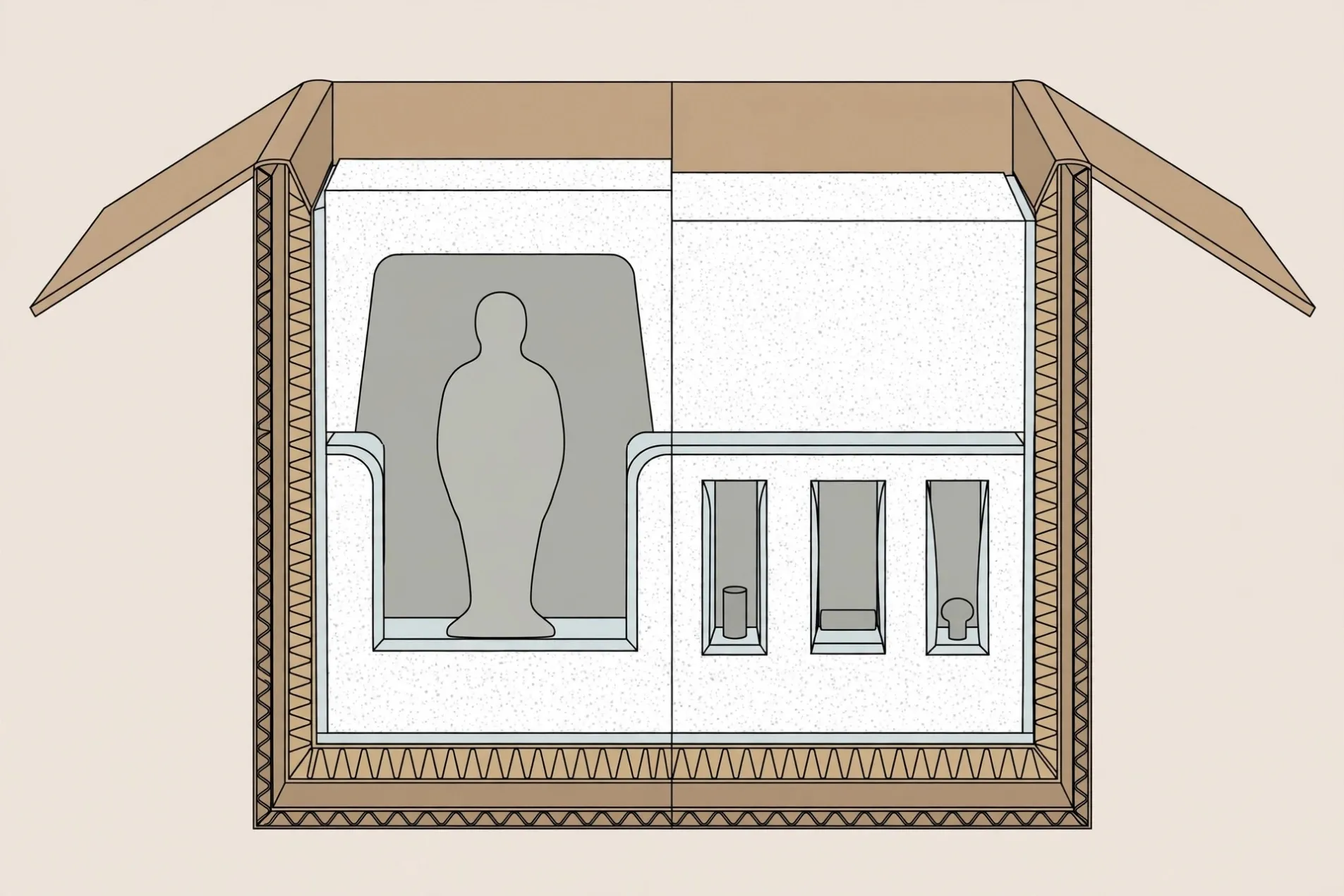
This is where the trade-off with protection gets uncomfortable. A resin statue needs its foam, its fitted slots, and its clearance — thin packaging is how statues arrive broken. But protection that is generous in the wrong places is money spent twice: once on the foam, and again on the freight for the volume the foam occupies. The work is to protect the break points — the thin limbs, the joints, the overhanging parts — and to keep the rest of the box as tight as the protection allows. A fitted foam insert that follows the statue's shape protects better than a larger box filled with loose fill, and it bills for less volume.
Why crowdfunding estimates go wrong
Crowdfunding is where this mistake does the most damage, because the shipping price is promised months before the product exists. At campaign time there is no packed sample to measure. The team estimates from the product's weight, or from a similar past project, or from a carrier's online calculator fed with guessed dimensions. Then the real product turns out larger, the packaging turns out thicker, and the carrier's divisor turns out less forgiving than assumed.
The Robotech RPG Tactics campaign on Kickstarter is a public example of how far this can go. The project team stated openly in a campaign update that dimensional-weight billing had become one of the largest unexpected cost increases on the project, and the second wave of rewards ultimately could not be delivered. The product was made. The freight is what broke the plan.
Dual Universe, another crowdfunded project with physical rewards, ran into the same wall from the other side: the cost of shipping the physical rewards rose until it rivalled the cost of producing them, and the team could not find a fulfilment partner willing to take the job on workable terms. In both cases the failure was not a bad product or a bad factory. It was a shipping estimate made before the packed dimensions were known, and never revised.
Freight vs parcel: the handover point
Shipping the whole run by sea or air freight to an overseas warehouse, then distributing locally by parcel, spreads the international leg across many units. The per-unit cost of the long leg falls, and the final delivery is a short domestic parcel. Shipping each unit directly from the factory to the buyer by international parcel avoids the warehouse and the second handling, but every unit pays the full international rate, and every unit is billed on its dimensional weight at international prices.
Neither route is always right. A small run may not fill a freight consignment efficiently. A large run sent as individual international parcels pays the dimensional-weight penalty on every box. The handover point — the volume at which freight-plus-local-delivery becomes cheaper than direct international parcels — depends on the run size, the destination mix, and the packed dimensions. It cannot be guessed from the product weight. It has to be worked out from the packed carton, the unit count, and real quotes for both routes.
What to measure before you promise a shipping price
Before any shipping price is promised, four numbers should be measured on a real packed sample:
- The outer dimensions of the finished carton, length by width by height, as it will actually ship.
- The gross weight of that carton, product plus foam plus box.
- The same two numbers for the alternative packing option, if there is one — assembled versus shipped in parts, for example.
- The unit count and destination mix, which decide whether freight or direct parcel is cheaper.
These numbers should come from the factory, measured on the packed sample, and they should be treated as part of the quotation — not as an afterthought the warehouse supplies later. A factory that can give packed dimensions and gross weight at the quotation stage lets the brand price its shipping on measurements instead of guesses. That is one of the practical things to ask for in a manufacturing RFQ: finished dimensions and weight, including packaging. For more on writing an RFQ the factory can quote accurately, see How to Prepare a Collectible Manufacturing RFQ That Can Be Quoted Accurately.
If the packed sample does not exist yet — which is normal at campaign time — the honest move is to publish a shipping range, to state what it is based on, and to say it will be confirmed once the packed sample is measured. Buyers accept a range. What they do not accept is a price that doubles after they have paid.
Designing packaging that ships cheaper
Packaging that ships cheaper is not packaging that protects less. It is packaging that protects exactly where protection is needed and wastes no volume elsewhere. Three design choices do most of the work.
First, fit the foam to the statue. A fitted insert that follows the figure's shape holds the break points firmly and leaves no empty volume around them. Loose fill and oversized boxes protect by distance, and distance is billed by volume.
Second, consider shipping in parts. A statue shipped as two or three fitted components can pack into a flatter, tighter carton than the same statue shipped assembled — and if the components are designed to join cleanly, the buyer does a minute of assembly instead of paying for a box full of air. The trade-off is real: assembly adds a step for the buyer and a joint that has to be engineered well. But for a tall or wide figure, it is often the single biggest saving on freight.
Third, keep the art box and the shipping box separate in the costing. The collector's art box is part of the product; the outer shipping carton is part of the freight. A strong outer carton that protects the art box in transit is necessary, but its size is a freight decision, and it should be sized — and costed — as one.
None of this is a substitute for protection. A statue that arrives broken because the packaging was thinned to save freight has not saved anything; it has converted a freight cost into a replacement cost. For more on the breakage side of the same problem, see Why Resin Statues Arrive Broken — and What Packaging Engineering Can Do About It. The aim is a box that is exactly as big as the protection requires, and no bigger.
Tell buyers the shipping cost early
The last part of the problem is not logistics at all. It is communication. Shipping cost disputes after a campaign or a pre-order almost always trace back to the same thing: the buyer learned the real price at the wrong moment — at checkout, or in a "shipping update" months after paying, or at the door.
The practical rule is simple. Publish the shipping cost, or at least a realistic range, as early as the product price. State what it covers, and state what would change it. If the final packed dimensions are not yet measured, say that the range will be confirmed once the packed sample is measured. If international delivery costs several times a domestic one — fulfilment providers publish guidance to that effect — say so plainly, rather than letting a buyer in another country discover it at checkout.
That honesty costs a few sales at the margin. It saves the kind that ends a brand: the buyer who paid, waited months, and was then asked for more money to receive what they had already bought. A shipping price that is transparent early is part of the product. A shipping price that appears late reads as a broken promise, whatever the freight market did in between.
A statue's freight bill is decided by its box, not by its weight. Measure the packed carton on a real sample, waste no volume, compare both routes on real quotes, and tell buyers the cost before they pay.
If you are planning a collectible and want the finished packed dimensions and weight quoted alongside the product — so your shipping price is built on measurements, not guesses — request a quote.