Why Resin Statues Arrive Broken — and What Packaging Engineering Can Do About It
Resin is rigid and brittle, so break points are predictable. What structural reinforcement and packaging engineering can do before the statue ever leaves the factory.
Why Resin Statues Arrive Broken — and What Packaging Engineering Can Do About It
Few moments in collecting are worse than the unboxing. A buyer waits months for a limited resin statue, opens the box, and finds an arm snapped off, a hair strand broken, or a crack across the base. The statue is not just damaged — the whole purchase is damaged with it.
This is not a rare complaint. Statue Forum has run a pinned thread collecting Sideshow quality-control complaints since 2012, and broken pieces arriving in the box are among the most repeated reports in it — hair, limbs, and thin parts snapped in transit. The AnimeCollective buying guide for unlicensed anime statues warns that breakage is common and usually traces back to poor packaging. A Rebelscum forum thread on Gentle Giant statues reports the same pattern across multiple pieces, and Etsy buyers describe statues packed in nothing but a thin layer of bubble wrap, arriving broken.
In September 2026, the pattern reached a mainstream release: the maker of the Gears of War: E-Day collector's edition statue publicly acknowledged that a small number of customers had reported statue components arriving damaged, and said it was investigating. When a problem is visible enough for a publisher to address it on a public support page, it is not an edge case. It is a structural issue in how resin statues are designed, packed, and shipped — and most of it is preventable before the run starts.
Why Resin Breaks and PVC Usually Doesn't
The first thing to understand is that breakage is a material property, not bad luck. Resin — the cast polyurethane resin used for most high-detail statues — is rigid and brittle. It holds fine detail beautifully, which is why sculptors and collectors love it, but it does not bend. When a force exceeds what a thin section can carry, resin does not flex and recover. It snaps.
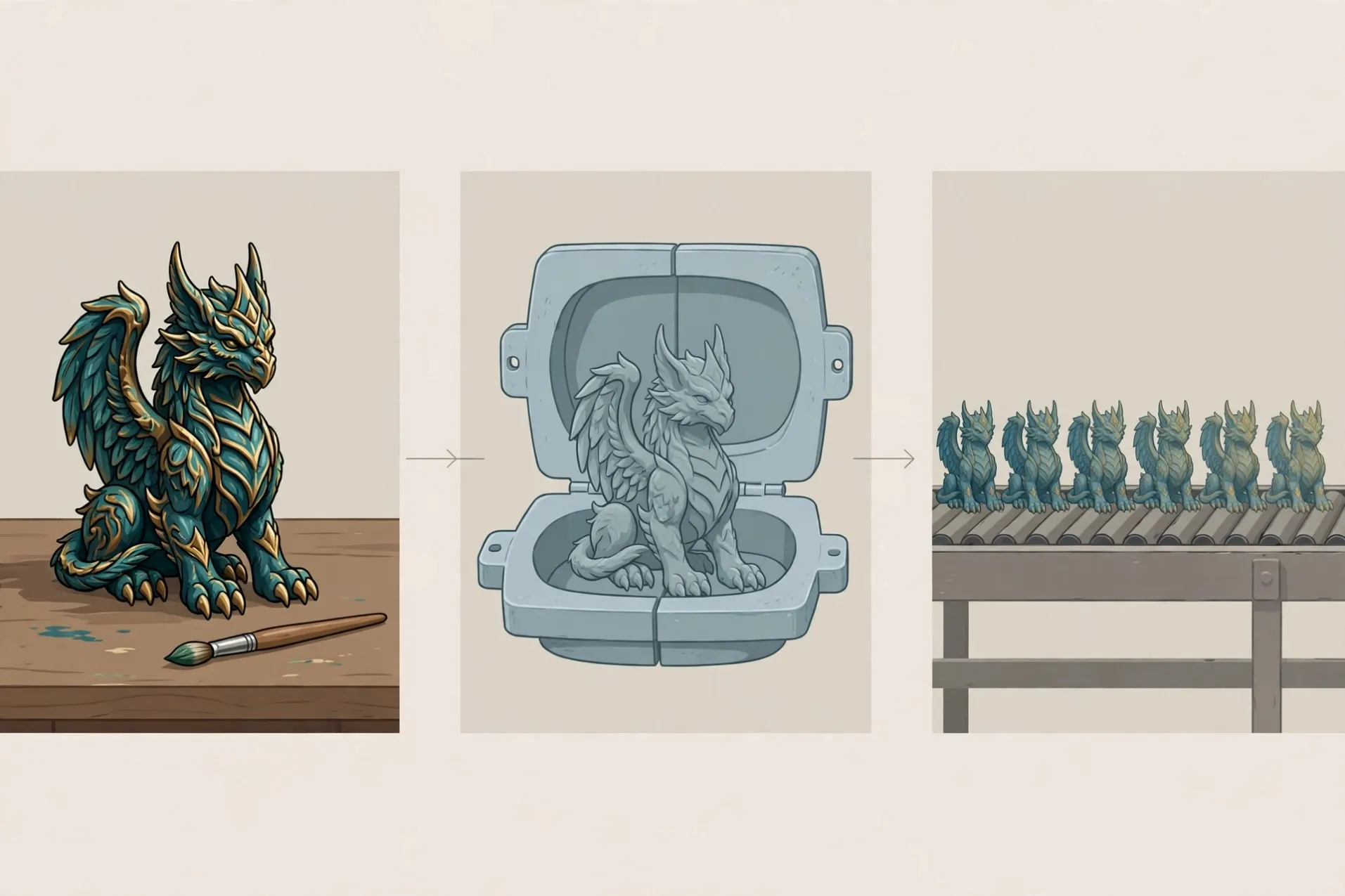
PVC and ABS, the plastics used for most action figures, behave differently. They are tougher and more flexible: a thin part can bend under load and spring back. That is why a PVC figure can survive a drop that would crack a resin statue of the same shape — and why the two materials are not interchangeable for the same design. A pose with thin, extended parts that works in PVC may be unshippable in resin.
This matters at the briefing stage, not the packing stage. A brand that chooses resin for its detail and premium feel is also choosing a product that needs structural thinking from the start. If the design is decided first and the material second, the factory is left protecting a shape that was never engineered to travel.
The Break Points Are Predictable
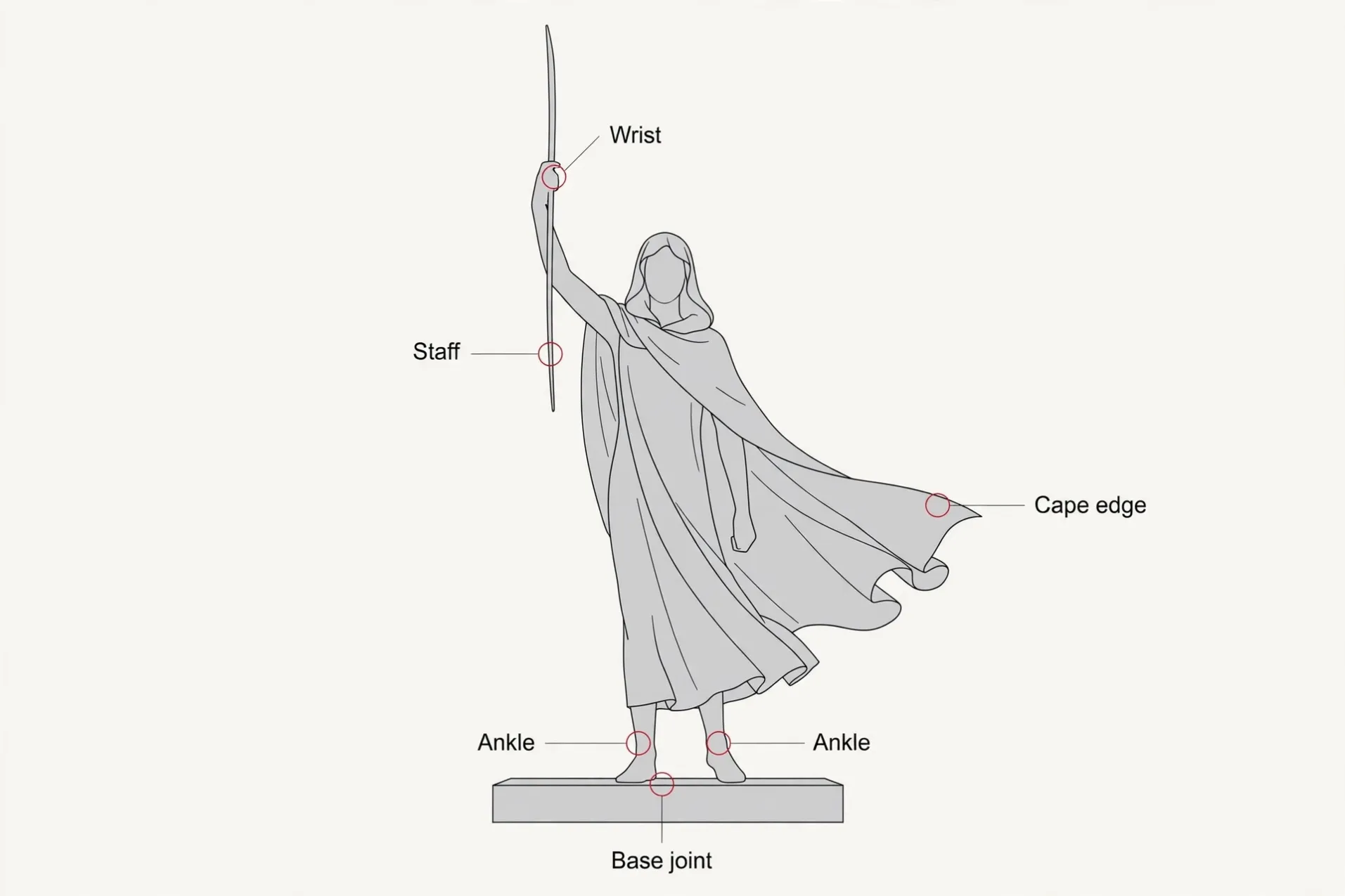
The complaint threads make clear that breakage is not random. The same places fail again and again: thin ankles carrying a heavy upper body, wrists holding a long weapon or staff, flowing hair strands and cape edges, and the joint where the figure meets its base — points where a small cross-section carries a large load, or where a protruding part has no support of its own.
That predictability is good news: if the failure points can be listed before production, they can be designed against. A brand or product team reviewing a sculpt should be able to point at each thin section and ask three questions: what holds this up, what happens to it if the box is dropped on its side, and what happens if the box is stored upside down in a warehouse. If no one can answer, the design is not ready for tooling.
(Illustration: typical break points on a resin statue — wrist, thin staff, cape edge, ankles, and the base joint. Generated illustration, not a photograph.)
Structural Reinforcement Before Paint
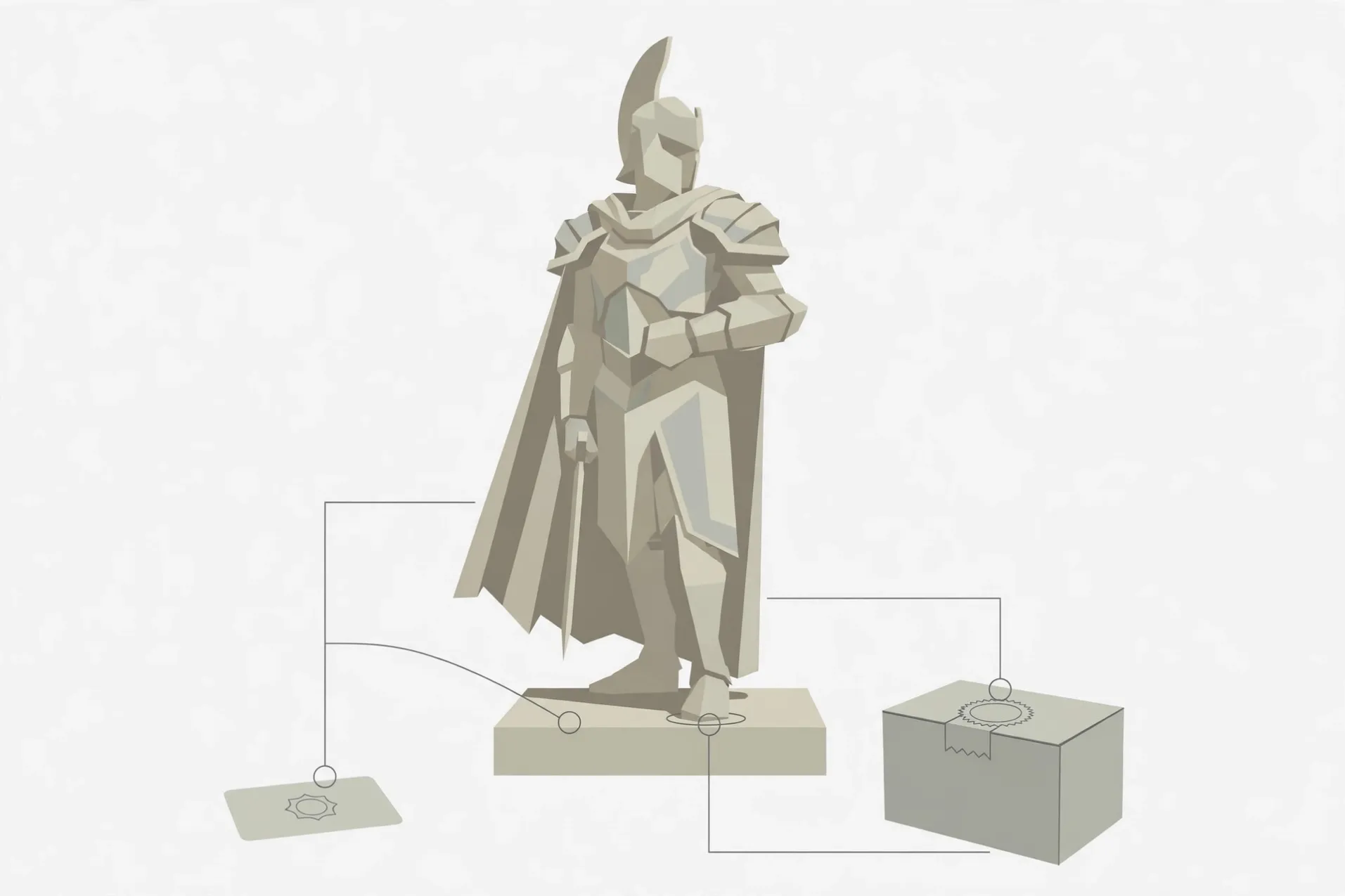
The strongest fixes happen inside the statue, before a drop of paint is applied. Thin load-bearing sections can be reinforced with embedded metal rods or pins — an armature inside a leg or an arm carries the load the resin alone cannot. Joints where parts meet the body can be thickened, and hollow cast sections can be given thicker walls at the points that take the most stress. Part breaks — the places where a statue is split into separate cast pieces — should be placed where they reduce risk: a separate arm is easier to pack safely than an arm cast as part of a fragile whole, provided the joint is engineered to be strong and invisible.
None of this is visible in the finished product. But the factory must plan it during sculpt review and prototyping: once the moulds are made and the paint master is approved, adding structure means rework, new moulds, or both. The cheapest time to prevent a break is before the first production mould exists.
Packaging Is Engineering, Not an Afterthought
Even a well-engineered statue will break if the packaging treats it like a generic object. Resin statues need packaging designed around the specific piece: foam inserts cut to its exact shape, so nothing can shift in transit; each accessory in its own cavity, not loose where it can knock against a painted surface; the statue held in the orientation it travels best in, not the one that looks good in the box.
The foam matters more than most buyers realise. A loose fit lets the statue move, and movement is what breaks thin parts — a statue rattling in its cavity takes hundreds of small impacts over a long journey. A tight fit, on the other hand, can press on painted surfaces and cause the packaging itself to damage the product, a separate problem covered in the next article in this series (012, When the Packaging Damages the Product). The right insert holds the statue firmly at its strong points — the base, the torso, the thick sections — and leaves the fragile points untouched, with clearance around them.
Shipping orientation is part of the same decision. A statue standing upright may be safest on a shelf, but one shipped lying down, its weight distributed across the foam, may survive a rough journey better. There is no universal answer; the answer depends on the sculpt. What matters is that the orientation is chosen deliberately, tested, and recorded — not left to whoever packs the box that day. Packaging should be treated as part of the product, not as a cost to be squeezed after the statue is finished: see Should Collector Packaging Be Treated as Part of the Product? (W03) and How to Plan Packaging Contact Points for a Painted Collectible (W29).
Drop Testing: What It Proves and What It Doesn't
At Mancheng, packaging is drop-tested before approval — the packed box is dropped from a set height onto a hard surface, on each face, edge, and corner, and the statue inside is inspected afterwards. A pass is real evidence: it shows the packaging can protect the piece against the kind of single impact a parcel is likely to take.
But a drop test has limits, and an honest factory will say so. A drop test proves the packaging survives a controlled impact; it does not prove the statue survives a month in a distribution chain, stacked under other boxes, vibrating in a truck, handled by several different carriers. It does not test what happens when a box is stored on its side for weeks, or when heavy cartons are stacked on top of a light one. Vibration, compression, and temperature changes all cause failures that a single drop never will.
Treat the drop test as a minimum standard, not a guarantee. Ask the factory: what height, how many drops, on which faces, with what pass criteria — and what else was tested? A factory that can show a test record, with photos of the packed box before and after, is giving you something you can rely on.
Shipping Assembled vs Shipping in Parts
One of the most consequential packaging decisions is whether the statue ships fully assembled or in parts. Each option trades one risk for another.
Shipping assembled is the better unboxing experience — the buyer opens the box and the statue is there, complete. But an assembled statue is larger and more awkward, with more exposed fragile parts, and it needs a bigger box with more protective material. Every thin, protruding section is at risk for the whole journey.
Shipping in parts reduces that risk: arms, weapons, and delicate accessories travel in their own cavities, and the box can be smaller and better protected. But it shifts risk to the buyer. Assembly instructions must be clear, joints must be designed so a non-expert cannot fit a part the wrong way, and every connection must be strong enough to survive handling by someone who has never assembled a statue before. A part that breaks during buyer assembly is still a broken statue, and the buyer still blames the product.
What to Agree With the Factory Before the Run
Breakage prevention is mostly a matter of agreements made before production, not inspections after it. Before the run starts, a brand should have four things in writing with its factory:
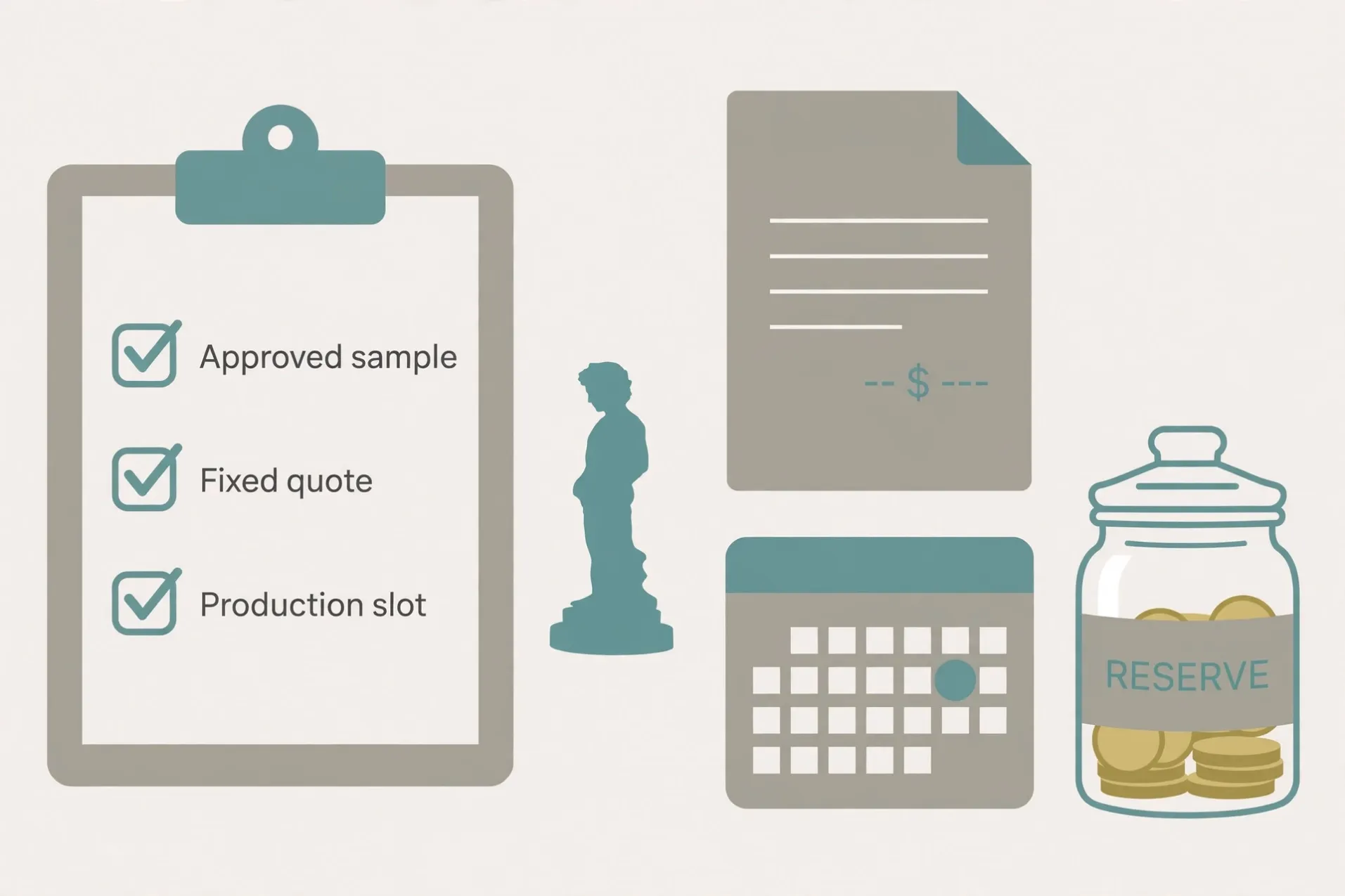
First, the packaging plan itself: insert design, materials, shipping orientation, and box specification, approved as its own sign-off — separate from the product sample approval, because a perfect statue in a bad box is still a broken statue.
Second, the drop-test record: what was tested, how, and what the result was, with photos. If the packaging changes after the test — a different foam, a different box — the test should be repeated.
Third, the structural decisions: where the reinforcement is and where the part breaks are, as checked at the prototype stage. These should be visible to the brand, not buried in the factory's internal notes.
Fourth, the breakage policy: what happens when a piece does arrive broken. Who supplies replacement parts, how quickly, and who pays the shipping? A factory that has a clear answer to this question is a factory that has thought about breakage seriously.
Resin statues break in transit because resin is brittle, because the same thin sections fail again and again, and because packaging is too often an afterthought. None of those causes is a mystery, and none is unfixable. They are engineering problems with engineering answers — reinforcement designed in before paint, packaging designed around the specific piece, testing that matches real logistics, and agreements written down before the run. A statue that arrives intact is not luck. It is the result of decisions made months before the box was sealed.
Sources: Statue Forum, "The Official Sideshow QC complaints Thread" (pinned since 2012, http://www.statueforum.com/archive/index.php/t-129669.html); AnimeCollective, "Guide to Buying Unlicensed Anime Statues" (https://animecollective.com/guide-to-buying-unlicensed-statues/); Rebelscum forum, "Quality Control: Gentle Giant Statues" (https://forum.rebelscum.com/threads/quality-control-gentle-giant-statues.921744/); Gears of War: E-Day Collector's Edition support page, September 2026 (https://www.gearsofwar.com/en-us/news/collectors-edition-support/).
About Mancheng: Mancheng Collectibles is a B2B OEM/ODM manufacturer in Dalingshan, Dongguan, China, with 10+ years of experience making resin statues and busts, PVC/ABS figures, 1/6 scale figures, and prop replicas with electronics. We manufacture under client authorization — design and IP belong to the client. Packaging is drop-tested before approval, and structural reinforcement and part-break design are confirmed before production. No fixed MOQ; assessed per project. No public prices.
Request a quote: Contact us — send your files (reference images and requirements) and we will review your project.