Your Sculpt Is Already on Sale — by Someone Else: Recasts and Bootlegs Undercutting Your Brand
A recast can reach the market faster than your second batch. Why copies are cheaper, what a factory can build in at production, and what to do when you find one.
Your Sculpt Is Already on Sale — by Someone Else: Recasts and Bootlegs Undercutting Your Brand
You launch a statue. The first batch sells out. Then a buyer messages you: the same sculpt is for sale on another platform, at half the price, from a seller you have never heard of. It is not your second batch. It is a recast — a copy made by moulding your finished piece — and it reached the market before your own restock did.
In collector communities, recasts and bootlegs are one of the most discussed problems a brand can face. The damage goes beyond lost sales: a cheap copy with soft details and bad paint teaches buyers that your sculpt looks worse than it does. This article explains how the copy gets made, why it can be so cheap, where the factory floor fits in, and what a brand can build into production to make copying harder and detection easier.
How a Recast Reaches the Market Before Your Second Batch
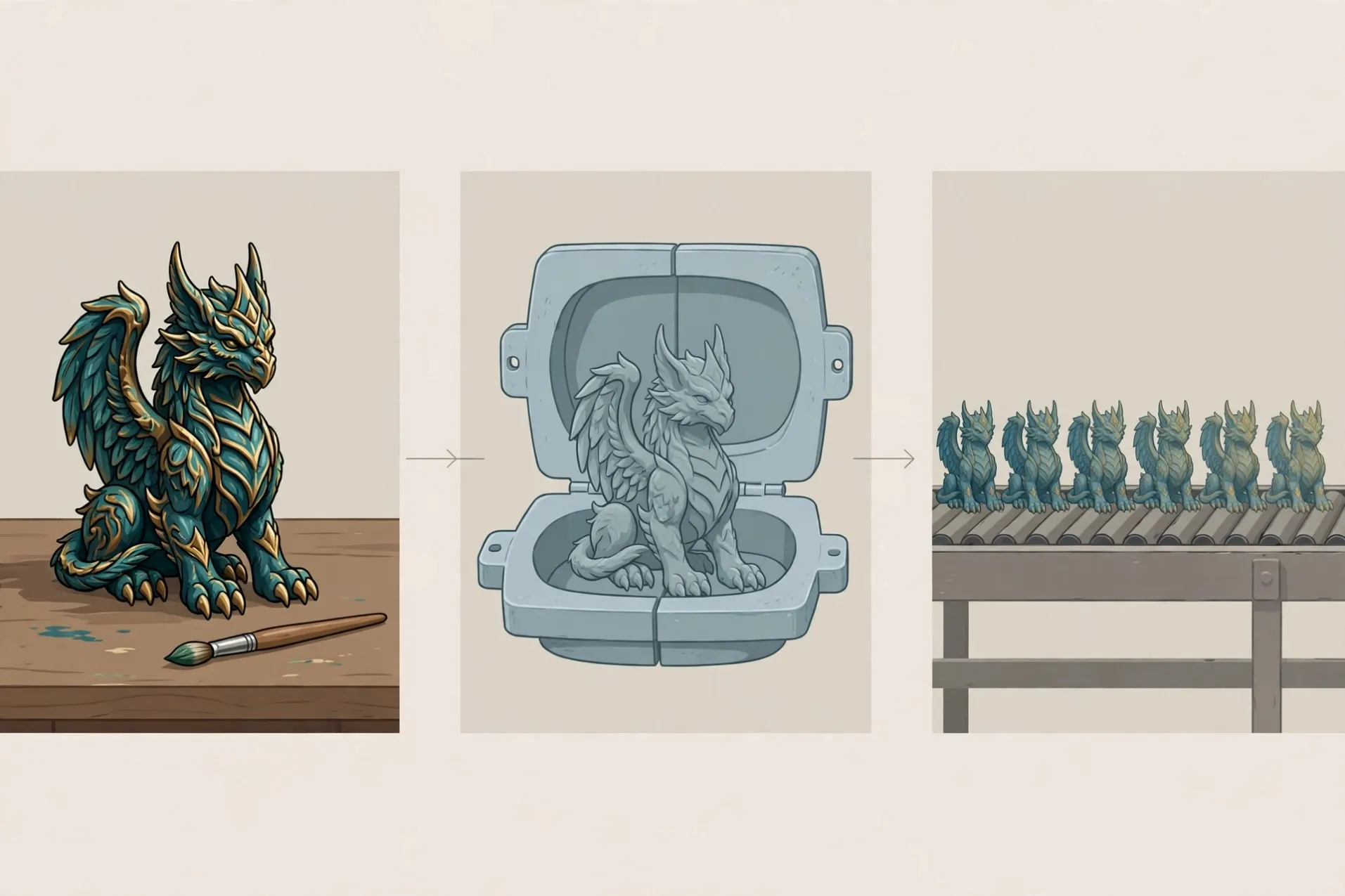
A recast needs no files, no moulds, and no permission. It needs one retail piece. Someone buys your finished statue, takes it apart, and makes silicone moulds from the parts. Those moulds cast copies in resin, which are painted fast and thin, packed in a plain or copied box, and listed on a marketplace. The whole cycle can take weeks. Your second batch needs a production slot, a paint line, quality checks, and shipping — so the copy can easily be on sale before your restock ships.
Collectors have described this pattern for years. On the KitMaker forum, a designer wrote that a factory can sell the genuine piece through the front door and the copy through the back door. On MyFigureCollection, a long-running bootleg guide lists the warning signs: missing logos, softened details, strange smells from cheap resin, prices far below the original, and mould lines where a recast was pulled from a copy mould.
The point for a brand is not that copies exist. It is that the copy's timeline is shorter than yours. If your defence starts only when the copy appears, you are already behind.
Why the Copy Can Be Cheaper
A recast is not a better factory. It is a factory that skipped most of the costs.
Your price pays for things the copy never buys: the sculpt, the master mould, the paint master developed and approved in stages, the quality checks that rework or reject failed pieces, the engineered packaging, and the licence fee where the design is licensed.
A recast skips almost all of that. There is no sculpt to commission, because your finished piece is the sculpt. There is no master mould to engineer, because a silicone mould taken from your piece is the mould. There is no paint development, because the copy is painted by eye to look close enough at a glance. There is no quality system, because a copy that fails is still sold. And there is no licence fee, because the copier never asked for one.
Arguing about price alone does not work. A buyer comparing your price with a recast's price is comparing two different products with two different cost structures — the answer is to make the difference visible, and to build in marks that let a buyer tell the two apart.
What the Factory Floor Has to Do with It
A recast can start with a single retail purchase, and no factory can stop that. But the factory floor is where the bigger leaks happen, and it is where a brand has real control.
A production run creates three things a copier wants: the moulds, the 3D files, and the knowledge of how the piece is made. A silicone mould has a limited life, but while it is alive it can produce far more pieces than the order calls for. A 3D file sent to a factory can be copied in seconds.
So the factory question is not "can you make this?" but "how do you keep what you make from leaving the building?" A serious factory should be able to answer, in plain language, how it stores moulds, who has access to 3D files, how it records pieces cast against pieces ordered, and what happens to a mould when the run ends. If those answers are vague, the risk is real: forum accounts describe moulds being copied and handed to a relative's workshop across the street.
Mould control is the most concrete part. Every mould should carry a number, and the pieces cast from it should be recorded against the order. Surplus pieces — spares made to cover breakage and QC rejects — should be agreed in writing before production, not discovered afterwards. When a mould is retired, the brand should know whether it is stored, returned, or destroyed.
What a Brand Can Build In at Production
You cannot make a statue uncopyable. You can make a copy easy to spot and hard to sell as genuine. The tools for that are built into production, not added afterwards.
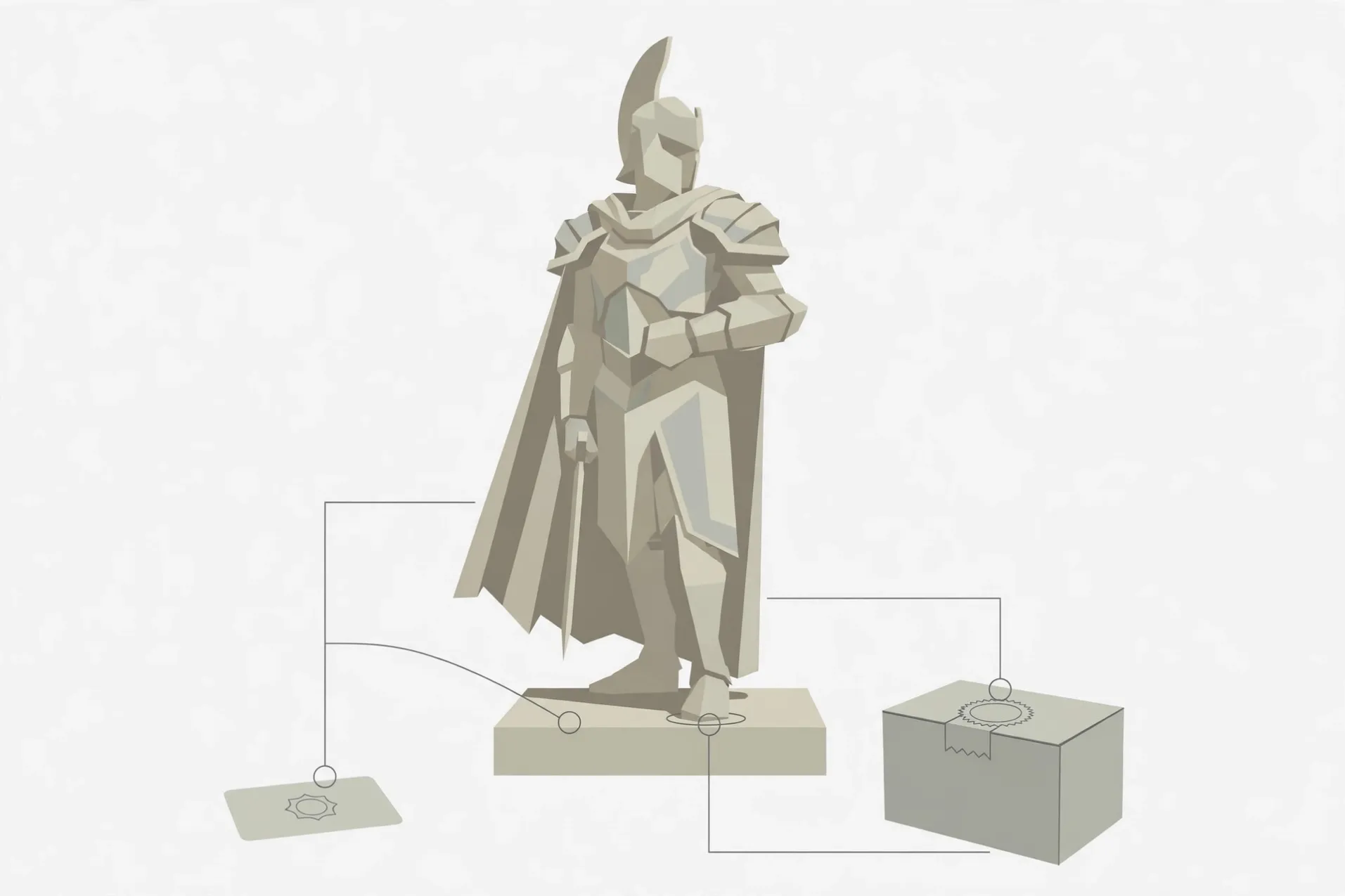
Edition numbering. A number engraved or printed on the base — for example, 047/500 — turns each piece into a specific object. It only works if it is real: the factory must record which numbers were made, and the brand must not quietly make more. A certificate matching the number on the base gives the buyer a second point of comparison.
A mark that is hard to copy. A small laser-etched mark under the foot, a moulded detail inside a cavity, a specific texture in an unseen area — cheap to add during production, hard to reproduce from a recast, because the recast copies the surface and loses the detail.
Tamper-evident packaging. A seal that breaks when the box is opened, a sticker that cannot be peeled and reused, a packing record matching the piece inside — these do not stop a copy, but they stop a copy from being sold in your box. Collectors already look for these signs; the MyFigureCollection bootleg guide lists packaging details among the first things to check.
A production record. Keep a simple record for each run: mould numbers, pieces cast, pieces shipped, pieces rejected, spares held. If a copy appears, the record is what lets you say, with confidence, "we made 500, and this is not one of them."
None of these measures is expensive on its own. Together they change the copy's economics: the copier must now fake the number, the mark, the certificate, and the seal — and every fake is another place a buyer can catch them.
Choosing a Factory That Does Not Double-Dip
Most of this comes down to one decision: which factory you trust with your design. A factory that also makes unlicensed copies is not a factory with a side business. It is a factory whose business model depends on your design leaking. Ask these questions before the first order, and get the answers in writing, not in conversation:
- Does the factory only manufacture under client authorization? It should state plainly that it produces only authorized work, that designs and intellectual property belong to the client, and that it will not produce a client's design for anyone else.
- How are moulds managed? Ask for the numbering, the casting records, and the end-of-run procedure. A factory that already does this will show you the records; one that does not will change the subject.
- Who sees the 3D files? Files should go to named people for a named purpose, and the factory should be able to say who they are.
- Is there an NDA process? A factory that welcomes a non-disclosure agreement and handles one routinely is signalling that it takes confidentiality seriously.
- Will the factory put it in writing? Mould ownership, spare-piece quantities, and confidentiality should be agreed before production, in the order documents. If a factory will not write it down, assume it will not do it.
This is the same evaluation a brand should apply to any manufacturer — see our guide on how to evaluate a collectible manufacturer before starting production. The cheapest quote is rarely the cheapest outcome.
When You Find a Copy: The Practical Order of Action
Finding a recast is unpleasant, and the first instinct is usually to argue with the seller. A calmer order of action works better. None of these steps is legal advice — for legal questions, ask a lawyer who knows intellectual property in the relevant market.
- Keep the evidence. Save the listing with its price, photos, seller name, and date. Take screenshots, because listings disappear. If you buy a copy for comparison, keep the packaging, the receipt, and the piece itself.
- Check it against your production record. Confirm the piece is not yours: the edition number, the mark, the certificate, the packaging. Write down exactly how you know.
- Report it to the platform. Marketplaces have takedown and complaint procedures for infringing listings. A report that includes the listing, your production record, and the differences between the copy and the original is far more likely to succeed than one that only says "this is fake."
- Tell your dealers and your collectors. A short notice — where the copy was found, how to tell it apart, and where to buy the genuine piece — protects your buyers and makes the copy harder to sell.
- Look at the leak, not just the listing. A copy that appears before your second batch points to a specific moment: a retail purchase, a mould, a file, a subcontractor. Work out which one it was, and close that route before the next run.
The Real Cost of a Recast
A recast is not only a lost sale. It is a buyer who paid for your sculpt and received a soft, badly painted copy, and who now believes your brand makes soft, badly painted statues. It is a collector who checks the edition number on their piece and wonders whether it means anything. It is a second batch that sells slowly because the market is already full of copies at half the price.
Mancheng Collectibles manufactures resin statues and busts, PVC/ABS figures, 1/6 scale figures, and prop replicas with electronics under client authorization. Designs and intellectual property belong to the client, non-disclosure agreements are welcome, and client identities are never disclosed. If you are planning a piece and want to build copy protection into the production plan — numbering, certificates, mould control, and packaging — request a quote and tell us what you are making.
This article describes production-side practices, not legal advice.