Don't Take Pre-Order Money Before Production Is Ready — the Cash Trap That Kills New Brands
Taking pre-order money before production is ready feels like funding — until costs surface and the next batch has to pay for the last. Three locks to set first.
Don't Take Pre-Order Money Before Production Is Ready — the Cash Trap That Kills New Brands
Pre-order money feels like proof that your product works. The page goes live, deposits land in the account, and the project looks funded. That feeling is exactly what makes pre-order cash dangerous: the money arrives before the real costs do. A new brand that opens pre-orders before production is ready is not selling a statue. It is borrowing from its own customers, at a rate it has not calculated, with a repayment date it cannot keep. Here is how the trap works, and what to do about it.
How the Trap Works
The trap has four steps. First, you open pre-orders on a design that is not finished: the sculpt is still being revised, the paint master is not approved, and the factory has not given you a final quote. But the render looks good, and deposits start arriving.
Second, the real costs surface. The factory's quote comes back higher than the number behind your pre-order price, tooling costs more than you budgeted, and your edition size does not divide neatly into the factory's minimum order quantity. Each is a normal production fact — discovered after you already promised a price that no longer works.
Third, you fill the gap with the next batch of pre-orders: a second product, a second edition, a new colourway. Each brings fresh deposits that cover the shortfall on the first, and for a while the account stays positive. But every new pre-order is another promise, and the promises are now funding each other instead of funding production. Fourth, something interrupts the cycle — a delay, a mould rework, a failed paint sample. Deposits stop because there is nothing new to sell, while refund requests arrive for the first run. The brand has no cash left that is not already committed to somebody else's order. It no longer has a production problem. It has a trust problem.
Public cases show the shape of it. On Statue Forum, the thread "What happened to Level 52?" followed a brand that took pre-orders, then cancelled production and stopped communicating; buyers found out themselves and chased refunds repeatedly. The same thread records one statue's edition cut from 50 pieces to 10, with only 8 pre-orders before cancellation (a forum poster's account, not independently verified). A Change.org petition about Bucket and Shovel describes hundreds of collectors who paid and received nothing for months, saying the company stopped answering refund requests; the petition's figures — hundreds of collectors, thousands of dollars — are its own wording, not independently verified data. Trustpilot reviews of Statuesque Ltd tell the same story from the retail side. Same mechanism: money first, production second, silence third.
The Three Things to Lock Before You Open Pre-Orders
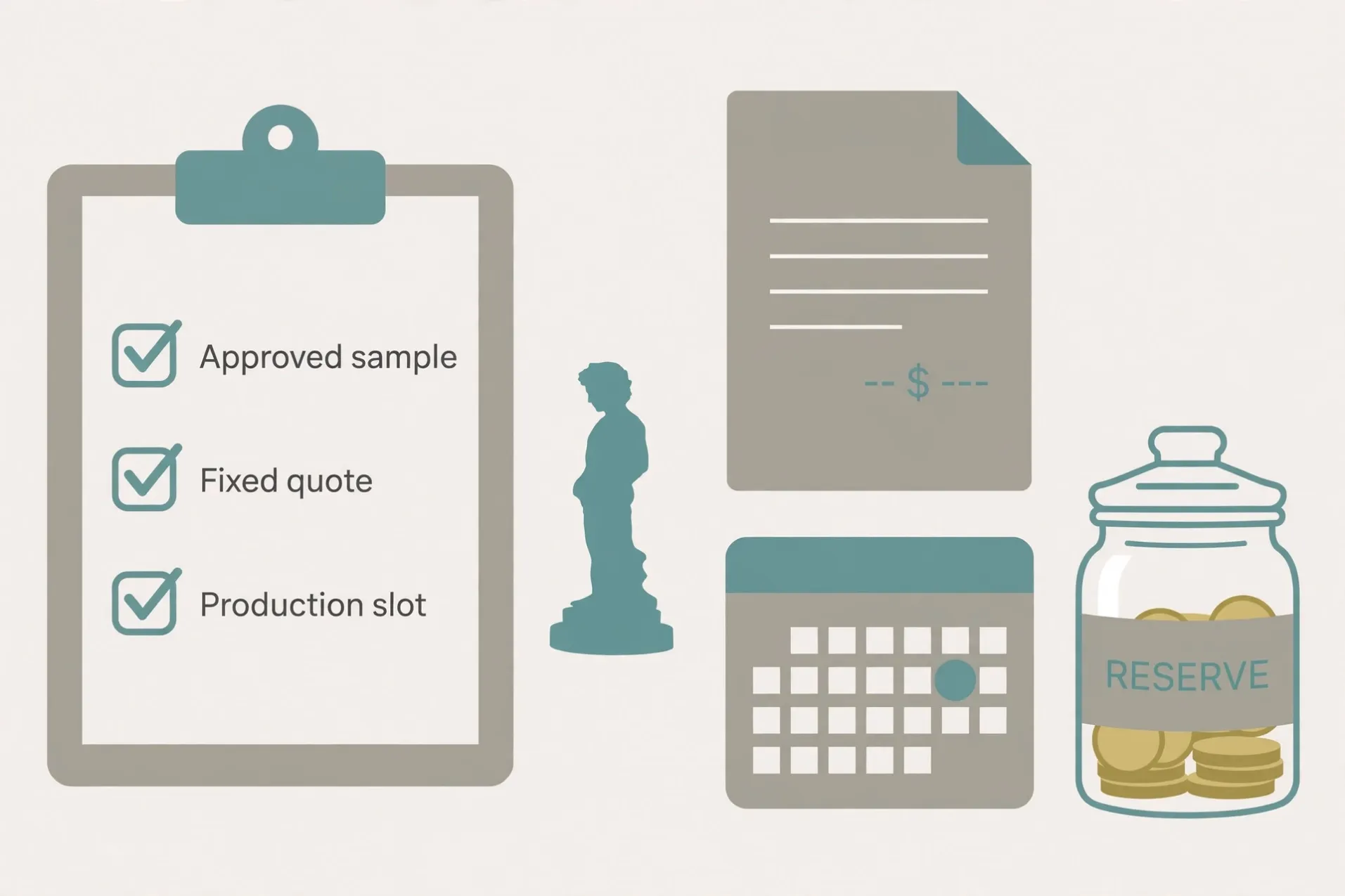
Three things must already be true, in writing, before the pre-order page goes live.
An approved sample. Not a render, not a grey print, not a painted prototype that is "almost final." An approved production sample — the piece you and the factory have both signed off on, in the exact materials, paint, and assembly the run will use. Until that sample exists, you do not know what you are selling.
A fixed quote. A quote tied to a defined specification: edition size, materials, finishes, packaging, and quantity. A ballpark figure from an early conversation is not a quote. If the factory can still change the price when the specification is finalised, your pre-order price is a guess, and your customers are funding the guess. Write the RFQ properly (see W20) and do not open pre-orders until the quote matches the product on your page.
A confirmed production slot. "We can probably start next month" is not a slot. A slot is a date in the factory's schedule, with mould time, paint line, and packing capacity reserved for your run. Without it, your delivery date is a wish. The sequence is fixed: sample first, slot second, pre-orders third. If any of the three is missing, you are not ready.
Deposit vs Full Payment: What Each One Commits You To
A deposit and a full payment are two different promises.
A deposit says: I am holding your place, and part of your money is at work while the rest stays with you. It obliges you to produce the piece or return the money, and the balance is only due when the product is real. A deposit on a product that does not yet exist is a loan with no agreed interest rate and no agreed repayment date.
A full payment says: the product exists, or is close enough that your money is a purchase, not a bet. Taking full payment before the sample is approved is the riskiest version of the trap: the brand holds 100% of the money and 0% of the finished product. If production fails, every buyer is owed a full refund, and no second payment is coming in to fund it.
The practical rule: take the smallest amount the stage justifies. A small deposit on a run whose sample is approved and whose quote is fixed is a normal pre-order. Full payment before the sample exists is a gamble with other people's money, and the house is the brand's reputation. Design the deposit policy before the first order is taken (see SEO 089 in this series).
When Pre-Orders Don't Cover the Run
Sooner or later, a new brand faces the arithmetic the trap hides: the pre-orders do not cover the run. The edition is too small for the mould cost, the factory's minimum quantity is higher than orders received, or the per-piece cost rose after the quote. Three honest options exist, each with a price.
Cancel the run. Refund everyone, in full, promptly. It costs most short-term — refunds come out of whatever is left, or the founders' own pockets — but least long-term, because it is the only one that leaves the brand's name intact.
Shrink the edition. Produce fewer pieces and tell buyers the edition is smaller than announced. This works only if the factory's economics allow it — a smaller run means a higher per-piece cost, which the brand absorbs — and only if the change is announced, not discovered.
Cover the gap yourself. Pay the difference from the brand's own funds and treat it as the cost of learning. This is what a brand with reserves can do. With no reserves, this option does not exist.
What is not an option is the fourth path: quietly take deposits for a second product to fund the first. That turns a production problem into a fraud allegation. The Level 52 thread is full of buyers who reached exactly that conclusion — one put it bluntly as "straight up theft." Once buyers use that word, the reputation is gone.
How to Cancel a Run Without Destroying Your Name
Sometimes cancelling is the right decision. How you cancel matters as much as whether you refund.
Announce it yourself, first, in one place. Do not let buyers discover the cancellation from a retailer, a forum post, or silence. One announcement, in the same channel where you took the orders, with the reason stated plainly. "The pre-orders did not cover the production cost, and we are cancelling rather than taking more deposits" is a sentence buyers can respect.
Set a refund order and a deadline, and publish both. Refund in the order payments were received, and give a date by which every refund will be made. Then meet it. A refund on the promised date is a closed wound. One that arrives after three rounds of chasing is a story told for years.
Answer every message. After a cancellation, customer service matters most. A short, honest reply — "your refund is scheduled for this date" — costs minutes. An unanswered email costs the brand's future. The Bucket and Shovel petition exists largely because refund requests went unanswered on Discord and by email.
Do not relaunch until the refunds are done. Nothing destroys a cancelled brand's remaining credibility faster than a new pre-order page appearing while old refunds are still outstanding.
The Reserve Rule
The reserve rule is the one piece of discipline that separates brands that survive a bad run from brands that do not: part of the pre-order money must stay untouched, set aside for refunds and rework, and it must never be spent on production.
Pre-order money has three jobs: pay for production, pay for fixing what goes wrong, and pay back people whose orders cannot be fulfilled. The second is the one new brands forget — a second sample round, a mould rework, a failed paint batch. The third is the one that kills brands: if the run is cancelled, refunds must come from somewhere.
How much to hold back is a decision for each project — edition size, cost structure, design risk — and no universal percentage fits every run. What matters is that the amount is decided before the first deposit is taken, written down and untouchable. A reserve that can be dipped into "just this once, to cover the mould" is not a reserve. It is a delay. Keep it in a separate account.
Pre-orders are useful: they prove demand, fund production, and let a small brand make something otherwise impossible. But they only work when production is already settled. The money should arrive last, not first: sample approved, quote fixed, production slot confirmed, reserve set aside — and only then the pre-order page. Before you open pre-orders, ask the question every case above failed to ask: if this run were cancelled tomorrow, could we refund everyone, in full, this week, without taking another deposit? If yes, you are ready. If no, the page is not a launch. It is a trap.
About Mancheng Collectibles
Mancheng Collectibles is a B2B collectibles manufacturer in Dalingshan Town, Dongguan, Guangdong, China. We work as an authorized OEM: your design and IP stay yours, we manufacture under your authorization, and NDAs are welcome. Our four categories are resin statues and busts, PVC/ABS figures, 1/6 scale figures, and prop replicas with electronics (sound and LED). No fixed MOQ — assessed per project — and no public prices. Before you open pre-orders, talk to the factory first.
Request a quote — tell us about your project before your customers ever see a pre-order button. Email: elina.liu@manchengcollectibles.com, WhatsApp: +86 135 1062 9408.
Illustration: the checklist image above is a generated illustration (Illustration), not a real photograph.