How to Review a Sculpted Cape Before Collectible Production
Review a sculpted collectible cape through its collar attachment, major folds, inner and outer surfaces, lining and hem before approving the final paint treatment.
A sculpted cape should be approved as a garment with a defined attachment, an inside and an outside, and a deliberate free edge. Before paint approval, confirm how those features connect across the shoulders, folds, turns and hem. A dramatic outer outline can conceal an unresolved collar or a fold that changes meaning when the statue is turned.
This is a useful review for brands developing a rigid statue with flowing costume elements. It concerns the cape's modeled form. Choosing a real fabric cape, proving connection strength and approving the final paint treatment remain separate decisions.
Start at the collar, not at the flying edge
Identify where the cape belongs on the costume. Does it emerge from beneath a collar, attach at two shoulder points or continue from another garment? The sculpt should give a consistent answer when viewed from the front, side and rear.
Follow the visible material from that attachment toward the broad hanging areas. A shoulder ornament should not appear to float above an unexplained opening, and a cape should not seem to grow directly out of the neck unless that is the intended fictional design. Ask the creative reviewer to resolve the costume relationship rather than asking the sculptor simply to add more folds.
Where the character reference does not explain the back, label the proposed interpretation for approval. An unseen fastening is an open design question, not an already approved detail.
Decide what each major fold is doing
Mark the few folds that establish the garment's main direction. Then identify which areas hang, gather, turn outward or sweep behind the figure. This gives the sculpt review a clearer target than a general request for more movement.
For a hypothetical cape attached at both shoulders, one section might descend close to the back while another opens away from a raised arm. Review how the transition between those areas is expressed. If every ridge has the same depth and spacing, the result may read as a repeated decorative pattern rather than the intended garment. That is an artistic judgment to resolve against the character reference, not a universal rule about how much detail a cape needs.
Keep large forms visible before refining small creases. Use a plain sculpt view alongside the proposed color treatment so that painted shadow shapes do not become the only explanation of the folds. The comic-style painting guide addresses the graphic finish; here the decision is whether the cape's physical form is resolved.
Trace the inside through every turn
Choose an identifiable location on the outer face and follow it around a rolled or folded edge. The surface should remain understandable as the same piece of clothing. Where a lining is intended, identify where that lining becomes visible and where it returns out of sight.
A contrasting lining can make an unresolved turn particularly conspicuous. Before selecting its color, agree which faces belong to the lining. Do not allow the painter to invent that boundary independently on each sample because the sculpt reference is ambiguous.
Review overlapping layers too. Identify which fold passes in front and which passes behind. Where a fold disappears into the body or another costume element, check the transition from an angle that actually reveals it. A front render alone may leave that relationship hidden.
Give the free edge a consistent identity
Inspect the hem as a continuous feature. Decide whether it is a simple fabric edge, a rolled border, a separate trim or an intentionally irregular outline. Those choices should remain coherent around corners and through the visible folds.
Review the apparent thickness at the finished size. A heavy-looking border may be intentional for a graphic design, while another character may call for a lighter appearance. Avoid treating a visually thin rendering as an agreed production dimension. The proposed edge still needs an engineering review for the selected construction.
Where the cape is divided into production parts, show how the join relates to the hem and fold pattern. Approve the assembled visual continuity rather than only the isolated pieces. Do not imply that an attractive join has proved its strength or repeatability.
Approve the form with evidence that exposes it
Retain views that show the collar relationship, a representative inward turn, overlapping folds and the complete hem. Review the rear as deliberately as the front. If a critical inner surface remains hidden, request a view that answers that specific question instead of collecting more photographs from the same flattering angle.
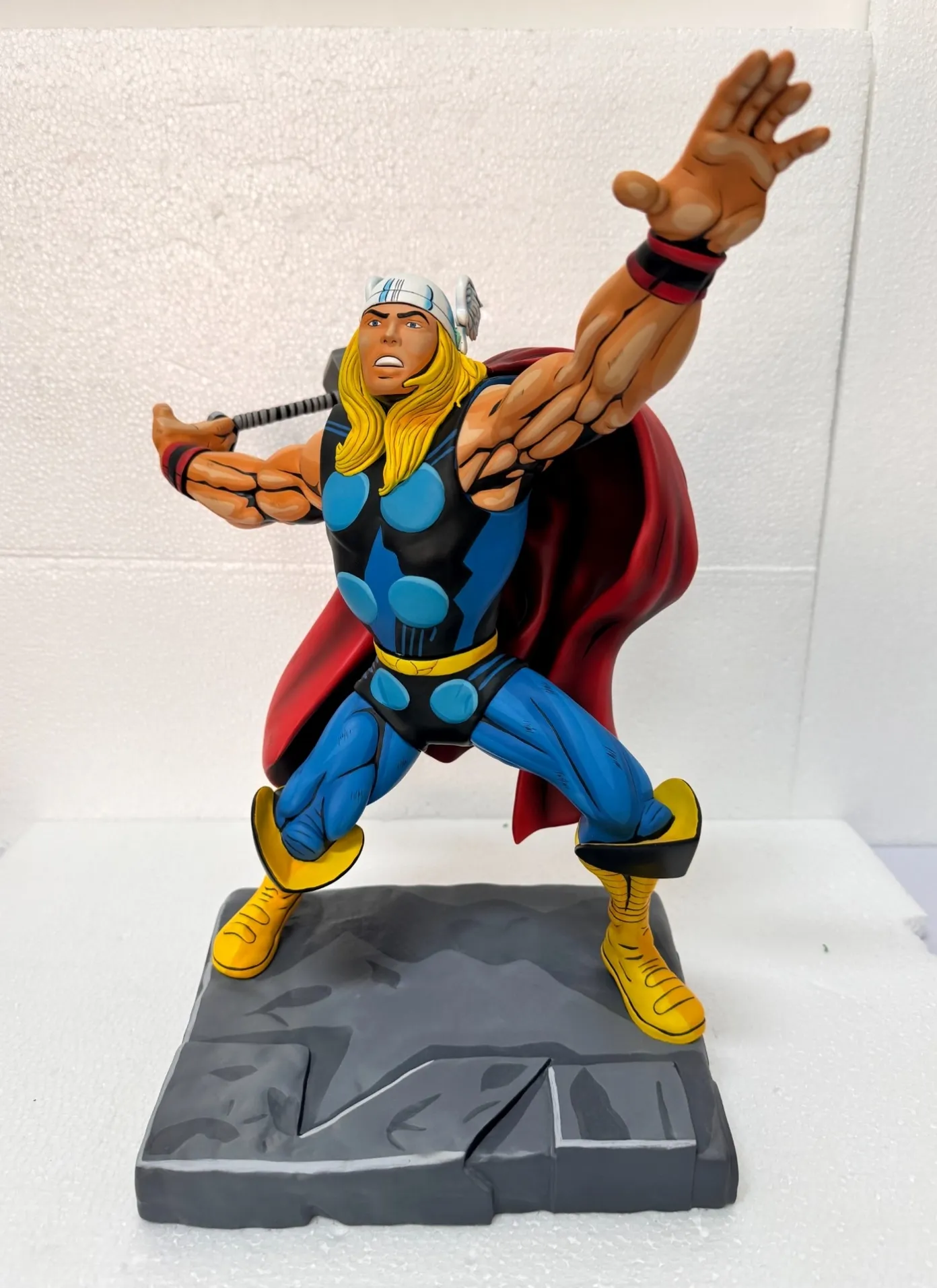
The accompanying finished-statue photograph shows a red cape with broad turns behind the figure. It illustrates a visible garment form and a free lower edge. It does not reveal every inner surface, the original sculpt approval, the material specification or a completed structural test.
Use the agreed form within the development and production process, retaining separate decisions for appearance, engineering and finish. A clear cape approval lets the next team understand where the garment begins, how its surfaces turn and which edge treatment must survive subsequent development. Paint can then describe an agreed form instead of being asked to resolve an unfinished one.
Frequently Asked Questions
Does every cape need many small folds?
No. The major forms should express the chosen garment and design language. Add small creases only where they support that intended reading.
Can a painted sample settle the cape sculpt?
It can help show the intended result, but compare it with a plain sculpt view where shadow graphics obscure the physical forms. Keep sculpt and finish decisions identifiable.
Does a visually thin cape edge prove production readiness?
No. Apparent thickness is an appearance decision. The actual edge construction, connections and production feasibility require their own engineering review.