How Much Scenery Does a Collectible Statue Need?
Choose collectible statue scenery around the intended moment, character focus, essential props and deliberate boundaries before defining the physical product scope.
A collectible statue needs enough scenery to make its intended moment clear, while leaving the character as the reason to look at the piece. Start with what the setting contributes, then choose its extent. A larger scenic base is justified when the additional environment changes how the pose, action or story is understood; it is not automatically a better version of a restrained base.
The useful question is not how many objects can fit around the figure. It is which information the collectible would lose without them. That distinction gives an overseas product team something concrete to approve before detailed sculpting turns every proposed prop into an assumed requirement.
State the scene in one sentence
Describe the moment the product should communicate. Is the character waiting on an ordinary street, arriving after a fight or moving across a particular environment? A sentence about the moment is more useful than a list of rocks, debris and effects with no agreed relationship.
Identify which environmental feature makes that sentence readable. A small section of paving might establish a street. A broken doorway might explain the direction of movement. Several additional objects may provide atmosphere without adding another essential part of the story.
Keep those roles separate in the brief. Mark what is essential, what is optional and what remains an exploratory suggestion. The sculptor can then develop the composition without having to preserve every item from an early mood board.
Compare a restrained and an extended version
Use the same character, pose and viewing setup to compare alternatives. Begin with the minimum setting that still communicates the chosen moment. Then add the proposed extension and ask what it improves.
For a hypothetical street scene, a character standing on paving with one discarded object could feel complete. Adding a wall, damaged vehicle and large effects would tell a different, more elaborate scene. That may be the intended product, but it should be selected for what it communicates rather than because empty space appears unfinished on a screen.
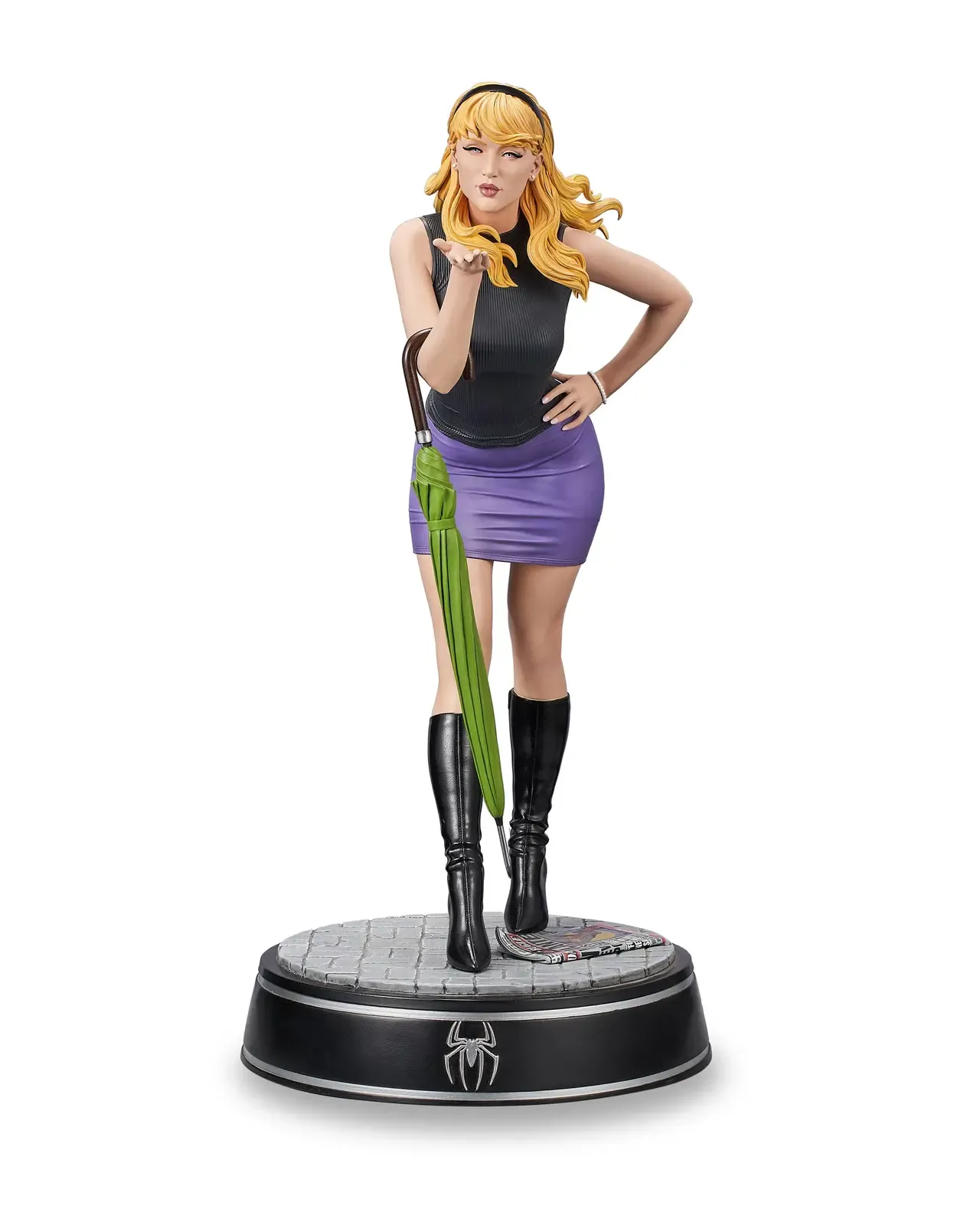
The pictured statue uses a shallow paving surface and a newspaper beside the figure. These visible elements provide setting information within a contained display base. The photograph illustrates that composition; it does not establish the original brief, production cost or an approval result.
The comparison should preserve alternatives long enough for a real decision. Polishing only the largest scene can make it seem more resolved simply because it has received more development time.
Protect the character's visual priority
Judge where the eye goes first. A scenic element can attract attention through its height, position, color or contrast. Decide whether that attention supports the portrait and action or leads away from them.
Look at the space around important features. An upright fragment behind the head may interrupt its outline. A bright object close to the face may become the most conspicuous area even when it is physically small. Moving or simplifying that element may be more useful than adding detail to the portrait to compete with it.
Review the scene as a whole before close inspection of textures. Individual props can be well sculpted while their combined arrangement feels crowded. Ask whether each item still has a clear role when the product is seen from its intended display position.
This is a composition judgment, not a rule that every base must be visually quiet. A deliberately dramatic environment can be the right choice when the relationship between character and scene is intentional.
Choose where the environment ends
A scene does not need to depict the entire location. It needs a deliberate boundary. Decide which surfaces are complete, which forms continue beyond the edge and how that edge meets the pedestal below.
An arbitrary crop through an important prop may look unresolved. Extending the base to include that prop completely may solve the composition, but another option is to remove the prop or move it within the existing boundary. Compare those choices before allowing every new object to enlarge the product.
Review the side and rear as well. The back can remain simpler than the main view while still completing the chosen scene. Specify that intention so an unfinished area is not confused with a deliberate reduction in detail.
Translate the selected scene into a product scope
Once the composition is chosen, identify the actual scenic components included in the release. State which effects or accessories are part of the collectible and which background elements belong only to promotional photography.
A removable environmental piece introduces a different owner experience from an integral one. That decision needs its own engineering and packing review. Do not assume that an attractive arrangement in a render establishes a practical construction or that scenery automatically provides structural support.
Keep this article's artistic decision distinct from coordinating bases across a series. A single statue's scene should first communicate its own intended moment; the range reference then determines how its presentation relates to other releases.
Carry the selected scope into the development and production process. Retain the approved composition and the reasons for including its key elements. When a later proposal adds another prop, the team can judge whether it clarifies that moment or changes the product into a different scene.
Frequently Asked Questions
Does a premium statue need a large scenic base?
No. The setting should serve the chosen composition. A restrained base can communicate a clear moment without a large environment.
Should every object in concept art become a physical component?
No. Separate essential product elements from optional atmosphere and photographic background before defining the sculpting scope.
Can scenery also act as structural support?
It may be proposed for that role, but its support function requires a separate engineering review. Appearance alone does not establish performance.