Should Collectible Display Bases Match Across a Series?
Coordinate display bases across a collectible series by defining shared visual rules, display relationships and intentional exceptions before approving each release separately.
Collectible display bases should share the characteristics that make the range read as a family, while allowing differences required by each character, pose and composition. Matching every dimension is rarely a useful starting rule. Define what the bases need to communicate together, then decide which visual features remain consistent and which may change.
This decision matters when products are developed and released separately. One base can look resolved on its own but feel disconnected beside an earlier release. The series needs a shared reference that survives individual sample approvals.
Choose the common visual language first
A base can connect a series through its edge profile, color, surface treatment, presentation height or relationship to the figure. The brand does not need to standardize all of them. It needs to decide which features carry the identity.
For a restrained range, a repeated pedestal profile may provide enough continuity while the top surface changes with the scene. Another range may use different shapes but retain a consistent material appearance and naming treatment. A narrative diorama may deliberately make each base different.
Write these choices before the first base becomes the accidental standard. A product team should be able to explain why two releases belong together without relying only on a shared logo or packaging design.
Separate family resemblance from identical hardware
Visually related bases do not automatically use the same physical part. A different stance, accessory or support arrangement may need another footprint or connection. Equally, a common-looking underside does not prove that the bases are interchangeable.
Keep visual coordination separate from the decision to share tooling, components or attachment interfaces. If actual part sharing is proposed, review geometry, finish and assembly requirements for every intended configuration. Do not promise manufacturing savings merely because the bases look alike in a rendering.
This distinction protects both the design and the quotation. The brand can request a consistent series appearance without unintentionally specifying one component for products that need different engineering.
Review the group at the same physical scale
Individual promotional images often fill their frames independently. A small figure and a large figure can appear equally tall when placed in separate panels. That presentation is useful for showing details but cannot approve the relative display relationship.
Review the proposed products together using a consistent scale and reference plane. Include already released pieces where possible. Observe how pedestal height, character size, pose and scenic elements affect the group. A crouching character does not necessarily need a taller base simply to align its head with a standing character.
Decide what the series is meant to preserve: character scale, a common overall height, a repeated pedestal proportion or another deliberate relationship. Those goals can conflict. Resolve the priority instead of trying to make every measurement match.
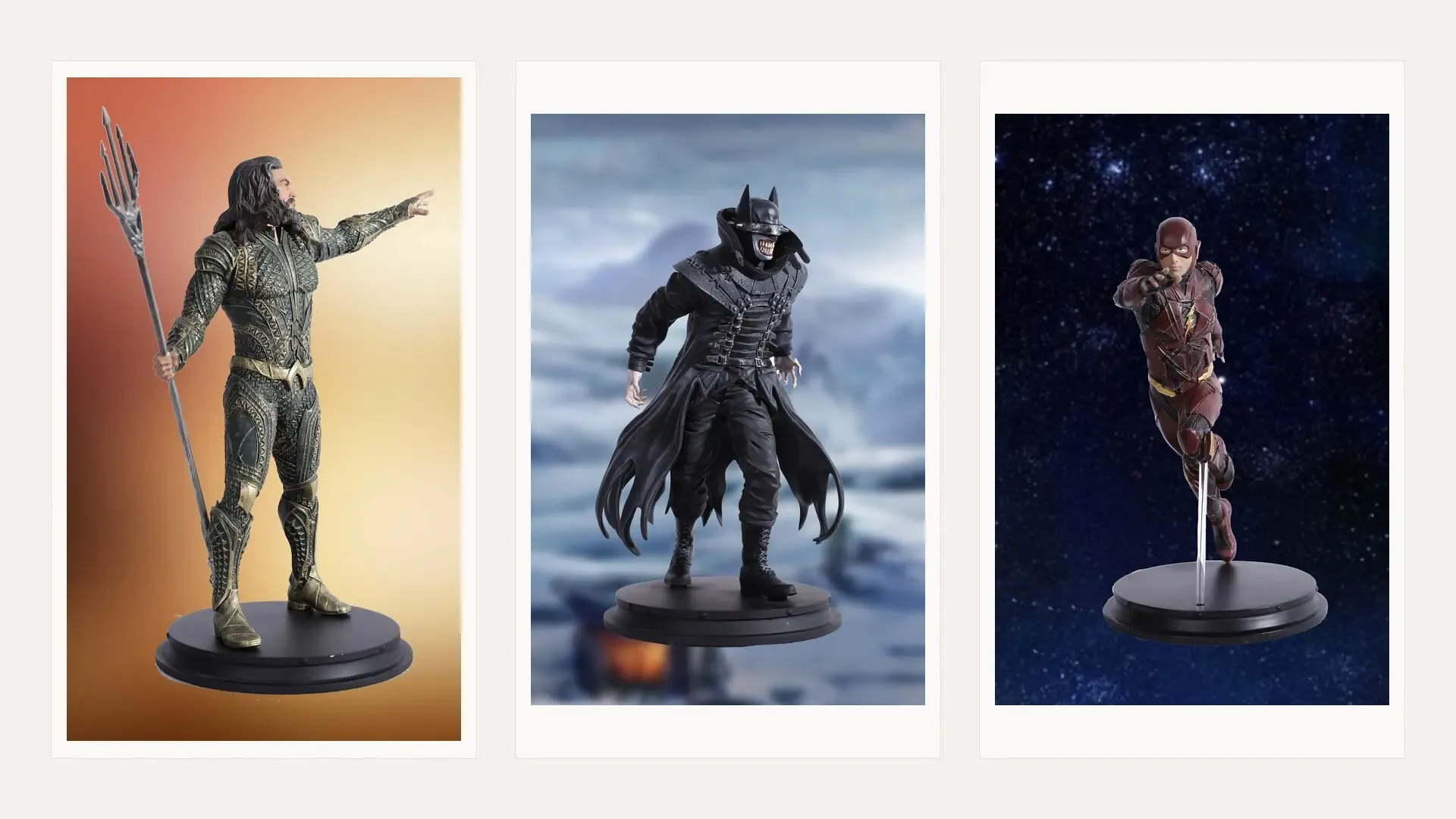
The image accompanying this article contains three separate product photographs with round display bases and different poses. It illustrates differences in base presentation and composition. The panels are not a same-scale lineup and do not establish that the products form one coordinated series or share components.
Give the shelf arrangement room to work
The base footprint is only part of the space a collectible occupies. A weapon, hand, cape or effect can project beyond it. Two bases may fit side by side while the figures above them overlap.
Consider the intended arrangement: a row, a staggered group, a central character with companions or independent display. Review the products from the expected viewing position, including the visible gaps between them. The purpose is to define a useful relationship, not to prescribe how every collector must arrange a shelf.
If bases are intended to join physically, treat that as a separate interface requirement. Specify which releases connect, how orientation is established and how an owner separates them. A photograph of adjacent bases is not proof of a working connection.
Approve exceptions deliberately
A large character or a dramatic pose may justify departing from the usual base format. An exception can strengthen the range when it is clearly intentional. It becomes confusing when a later release quietly changes the visual rules.
Compare the exception against the series reference. Can the edge profile remain familiar even if the footprint grows? Can the surface treatment link the new piece to the range without forcing the scenic sculpt into an unsuitable shape? Does the new presentation establish a rule that future releases will be expected to follow?
Record the answer in the product brief. A specific exception should not silently redefine the whole series, and a new series rule should not remain hidden in one sample approval.
Maintain a reference for the range
Retain a short series reference alongside the individual product specifications. Include the shared features, the intentional variables, approved examples and the display relationship used for review. Keep the current revision identifiable.
When a new release enters development, compare it against that reference before sculpt and base details become expensive to revisit. Review the actual samples together again before final approval. Screen comparisons can help locate a question, but physical viewing may still be needed for color, sheen and proportion.
This complements the guide to setting a collectible's overall size, which defines an individual product's dimensions. Series coordination asks how several approved products relate to each other. Both decisions belong within the development and production process.
A useful range standard gives each product enough freedom to work while preserving the visual relationship the brand intends to build over time.
Frequently Asked Questions
Should every base in a collectible series have the same diameter?
Only if that rule serves the intended range and works for each product. Shared profiles or finishes can create continuity even when footprints differ.
Can separately framed product photographs approve the relative sizes?
No. Images resized independently do not establish a common physical scale. Use a same-scale comparison and an agreed reference plane.
Does a matching base design mean the same tooling can be used?
No. Tooling and component sharing require their own review of geometry, interfaces, finishes and assembly requirements.