Where Should a Collectible Bust End?
Define a collectible bust’s cut line around portrait focus, costume details, shoulder and chest boundaries, finished edges and the transition to its pedestal.
A collectible bust should end where its head, shoulders, chest and pedestal form a deliberate complete object. There is no universal point on the torso that makes every bust work. Choose the lower and side boundaries around the character information the product needs to retain, then review those boundaries as visible designed surfaces, not as an accidental crop of a full figure.
This decision matters before the sculpt is treated as finished. A face can be strong while the rest of the object feels abruptly cut off, crowded onto its pedestal or unnecessarily extended below the features that give it meaning.
Decide what the bust needs to include
Begin with the product's focus. A portrait-led bust may need only enough shoulder and chest to frame the head. A costume-led design may depend on a collar, armor arrangement, emblem or other feature below the neckline. Identify what would be lost if the boundary moved upward.
Then ask what is gained by extending it downward. More torso is useful when it completes an important form or supports the intended composition. It is less useful when it simply adds an area that ends at another arbitrary point.
For a hypothetical armored character, cutting directly through the central insignia could undermine recognition. Extending the bust just enough to retain the complete insignia might solve that problem; including the entire abdomen is a different creative choice. Compare those alternatives before polishing the surface detail.
Design the side boundaries with the lower edge
The front lower edge is only part of the cut line. Shoulder width, arm termination and the depth of the back determine whether the form feels complete as it turns.
Review how the boundary crosses each anatomical or costume feature. A clean geometric termination, a contour following the costume and an irregular scenic transition create different objects. None should be selected merely because it hides an unresolved edge in the preferred photograph.
Consider the visual weight on both sides. An asymmetric collar or projecting shoulder ornament may be essential to the character, but it needs an intentional relationship with the rest of the bust. Do not restore symmetry automatically when the design calls for something else.
Make the transition to the pedestal intentional
Review the space between the torso and pedestal, including any visible stem or support. A narrow transition can emphasize the portrait; a broader one can make the object read as a more continuous sculptural mass. Judge the actual combination rather than choosing a pedestal in isolation.
Check whether the lower contour appears to meet the pedestal, float above it or disappear behind it. Reflections and shadows can make that relationship difficult to judge in a polished beauty image, so use clear views of the geometry as well.
These are composition decisions. They do not establish structural performance. The proposed support and connection still require their own engineering review; a broad-looking pedestal is not proof of a secure construction.
Review the boundary as a finished surface
A cut edge that remains visible needs an appearance decision. Is it intended to be flat, rounded, textured or integrated into another sculpted form? How should the visible underside relate to the exterior finish? Identify that scope before finishing begins.
Do not allow a temporary digital crop to become the production instruction by default. Check the side and rear views for incomplete costume elements, abrupt changes in thickness or a surface that was never resolved because it faced away from the main camera.
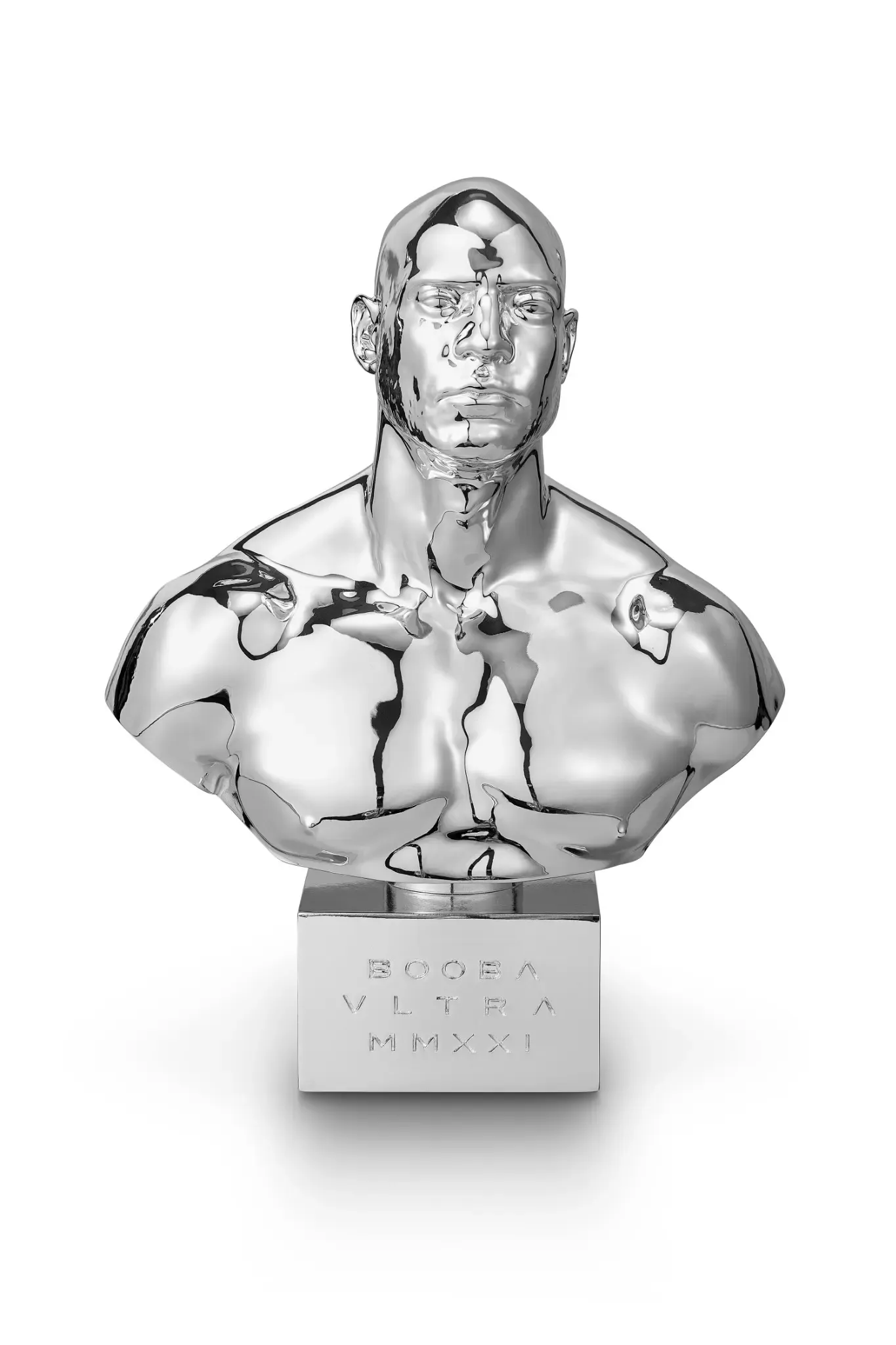
The silver-colored bust pictured here shows a defined shoulder-and-chest boundary above a rectangular pedestal. It illustrates the relationship between the portrait, torso termination and base. Its reflective appearance does not establish the underlying material, hidden support arrangement or a passed inspection.
Compare alternatives before releasing the sculpt
Keep comparisons consistent: the same head, expression and viewing setup, with the proposed cut line identified. Otherwise a different camera angle or a larger portrait can make one option seem preferable for reasons unrelated to the boundary.
Once selected, retain front, side, rear and lower-angle references of the complete bust and pedestal. Identify which visible edges and transitions are intentional. The development and production process can then assess that defined object rather than an unfinished torso excerpt. For the range of applicable formats, see statues, busts and other collectibles.
The result should feel complete because the product team chose what belongs in the bust and how it ends. Surface detail cannot make that decision on its own.
Frequently Asked Questions
Is there a standard chest height for a collectible bust?
No single cut suits every character. Choose the extent around the portrait, costume information and intended relationship to the pedestal.
Can a full-figure sculpt simply be cropped to create a bust?
It can provide a starting point, but the new side, rear, lower and support transitions need deliberate design and review.
Does the pedestal settle the support design?
No. Its appearance and proportion are separate from the engineering evidence needed for the actual support and connection.