Oct 29, 2026
What Should Be Verified Before a Collectible Shipment Is Released?
Verify collectible shipment readiness by matching product versions, accessories, packing references, labels and dispatch records before release.
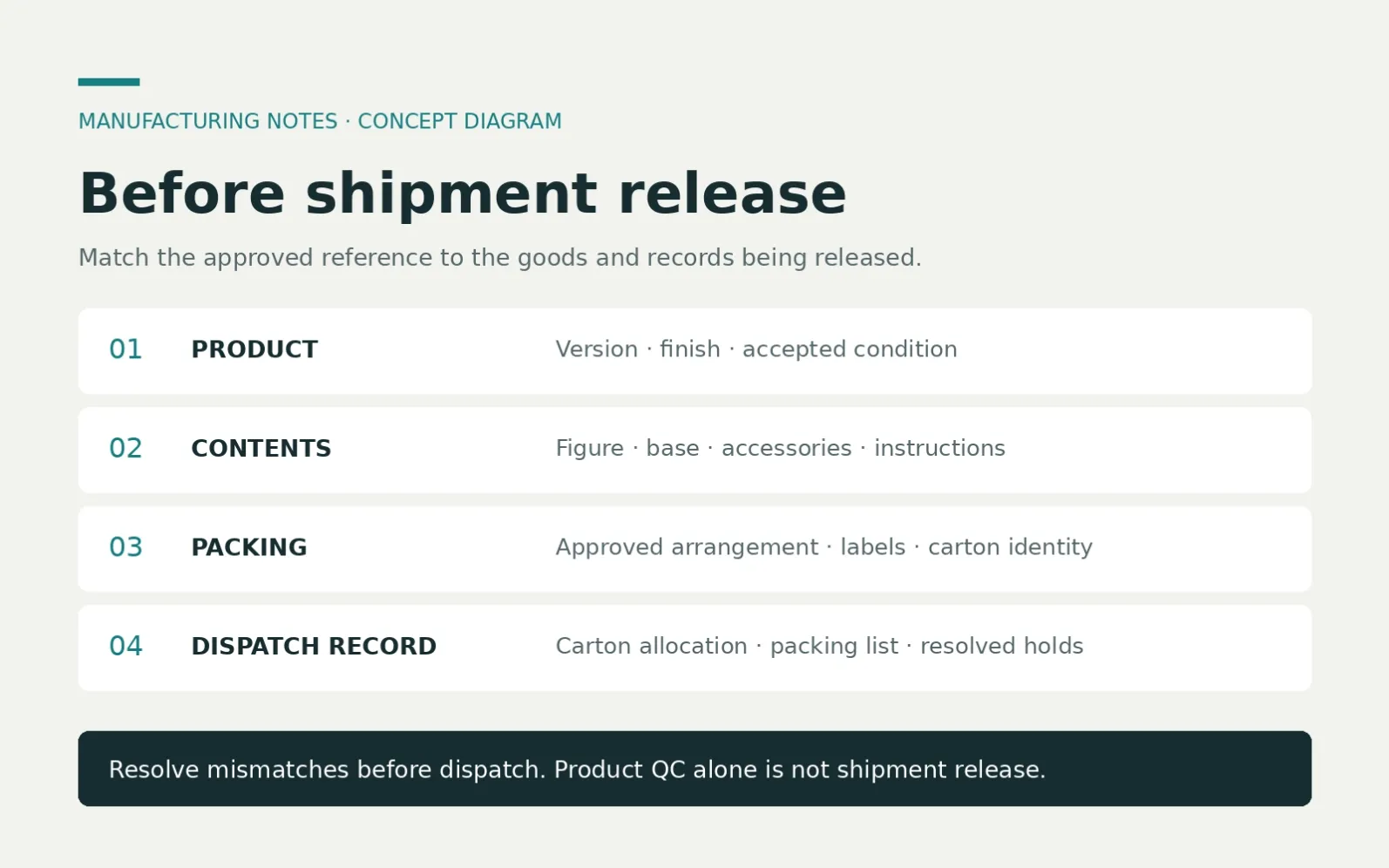
Before a collectible shipment is released, verify that the finished product version, included parts, approved packaging and carton identification all match the shipment instructions. Final product QC is one input to that decision. Release also requires evidence that the correct goods have been packed, identified and recorded for the intended dispatch.
A collectible can pass an appearance review and still leave with an incorrect accessory, outdated insert or mismatched carton label. These are practical handoff risks between production, packing and shipment preparation. The release review should connect those stages rather than assume that a successful check at one stage covers the rest.
Start with one current packing definition
Use an agreed reference identifying the product version, finish, included components, printed inserts and packaging arrangement. Make clear which revision is current and whether different destinations require different configurations.
The reference should distinguish a component included in every retail unit from one supplied separately. It should also identify deliberate exclusions. An empty space in a tray may be correct for one version and a missing part for another; the packing team needs an explicit reference to tell the difference.
If instructions or artwork change late, confirm which packed goods the change affects. An updated file does not establish that earlier boxes were reopened and corrected. Record the affected scope and the actual correction before treating the change as complete.
Reconcile the product, accessories and printed information
Check the configuration inside the package
Compare the actual packed configuration with the approved packing reference. Include loose accessories, interchangeable parts, display bases, instructions and other agreed inserts. Similar-looking components need clear identification where they belong to different versions.
For a product with LED, sound or mechanical features, confirm that the packed state and included items match the agreed instructions. An operating demonstration does not answer whether the correct accessories and owner information are inside the box.
Check what the outside says
Compare the retail label and carton marking with the product they identify. Review version names, item references, destination-specific wording and any required identification. Where a barcode is used, check it against the approved data and the agreed reading method rather than judging the printed appearance alone.
Keep the release question specific: does this identification describe these goods? A clear label attached to the wrong configuration is still a mismatch.
Review packing completion separately from product condition
Product inspection and packing verification answer different questions. The former concerns the collectible's condition and agreed functions. The latter confirms completeness, placement, protection and identification in its shipping configuration.
Inspect the assembled package using the intended closure and protective components. Check that the contents are seated as defined, that separately packed items cannot be confused with missing components, and that the packaging can be closed as intended. Detailed support design belongs in packaging contact-point planning; the release check establishes that the approved arrangement was actually used.
A closed-box photograph alone cannot demonstrate the contents. Conversely, an open-box photograph cannot establish the condition of the carton after closure. Select evidence appropriate to each question without treating a single image as proof of the entire shipment.
Keep held goods outside the released shipment
Reworked, incomplete and accepted goods should remain distinguishable through packing. A correction at the painting table is not the end of the record if the item still needs reinspection or repacking.
Identify what is on hold, the reason and the action needed before release. When a problem is found after packing begins, establish which packed goods may be affected. Correcting the visible example is insufficient if the same mismatch could exist elsewhere.
The inspection scope and acceptance criteria should be agreed for the project. Avoid implying that a photographed sample or an unspecified spot check establishes that every unit was checked in the same way.
Reconcile the dispatch record with the physical cartons
Before handover, compare the packed-carton record with the cartons prepared for dispatch. Confirm the item allocation, carton identification and the information required for the packing list. Where weight and dimensions are recorded, use the finished packed configuration and identify any mixed or partial cartons clearly.
Resolve discrepancies before the goods join the released shipment. If a carton is reopened, substituted or repacked, update the affected record and label. Otherwise, a previously correct packing list can become inaccurate during the final correction.
Keep evidence tied to the shipment and revision it describes. Useful records identify what was reviewed, when it was reviewed, any outstanding exceptions and who released the goods under the agreed process. Photographs should supplement those records rather than replace them.
Make the final handoff explicit
A dependable release is a connected decision: the product is accepted, packing is complete, exceptions are resolved and the dispatch information matches the physical goods. Booking collection does not by itself establish those conditions.
For professional teams planning collectible manufacturing, these responsibilities belong in the production process before the final shipping deadline. Agreeing the packing reference and release evidence early reduces rushed interpretation when the finished goods are ready to move.
FAQs
Does passing final product QC mean a shipment can leave?
Product acceptance is necessary, but packing completeness, identification and dispatch records must also match the agreed shipment scope.
Can shipment photographs replace a packing list?
No. Photographs document visible conditions. The packing list and associated records identify the goods and carton allocation prepared for dispatch.
What should happen when a packed carton is changed?
Recheck the affected contents and packaging, then update its identification and dispatch record before release.