How to Review a Collectible Packaging Mockup Before Production
Review a collectible packaging mockup by checking the product fit, inner protection, accessory cavities, opening route, shipping orientation and packing records.
A packaging mockup should answer more than whether the box looks attractive. Before production, it should show how the collectible, accessories, protection and printed materials fit together, how the customer opens the package and how the packing team can repeat the arrangement. Reviewing those decisions early prevents a finished product from being forced into an unsuitable carton.
Define the supplied configuration
Start with the exact contents that the package must hold. List the main figure, base, alternate parts, cables, instructions, certificates and any small accessories. A mockup that fits only the hero product can hide the real volume and handling problem created by the complete set.
Record whether the product enters the box assembled, partly assembled or separated for protection. That choice affects cavity shapes, the order of packing and the first action the customer takes after opening. Do not approve a box from a single product photograph when the shipment will contain several configurations.
Check the inner protection against real surfaces
Review where the tray or protective pieces touch the product and which areas remain clear. Painted edges, thin projections, fabric, clear parts and scenic details may require different contact rules. A cavity that holds a rigid base may be inappropriate for a delicate raised accessory.
Check the restraint direction as well as the empty space. The product should not rely on a loose filler to stop movement if the intended design needs a shaped support. At the same time, avoid claiming that a visual mockup proves a passed drop or transport test. Packaging protection needs the appropriate physical evaluation when that evidence is required.
The existing final assembly QC guidance helps separate product inspection from the packaging decision. A package can hold a visually approved product and still need a revised tray, divider or opening route.
Review accessory cavities and retrieval
Each accessory should have an identified location, orientation and retrieval path. Check whether the owner can see what is being removed and whether a small part can be lifted without pressing against the figure. If the package depends on a tab, ribbon or finger gap, show that feature in the mockup rather than describing it later.
Look for false openings. A cavity may appear generous from above while a side wall blocks the actual removal angle. Turn the product and accessories through the intended sequence and note where the hands must go. This is a usability review, not a claim about a particular customer experience.
Walk through the opening sequence
Review the package layer by layer: outer carton, printed sleeve or lid, protective film, tray, accessory compartment and product. Decide what the first view should reveal and which components need separate instructions. A beautiful top panel cannot compensate for a confusing or damaging opening route.
Keep the assembly order for packing visible. If a certificate must sit above the tray, or a cable must be placed before the figure is closed in, record it as part of the packing standard. This complements the development and sample process, where the product and its shipping condition can be reviewed together.
Confirm shipping orientation and records
Identify the upright direction, the parts most sensitive to pressure and the outside labels that the carton needs. For a multi-part collectible, the shipping orientation can determine whether the base, prop or transparent element receives the wrong load.
A mockup should also leave a clear record of what was approved: product configuration, cavity map, printed version, packing order and open questions. Keep replacements and later corrections tied to the same revision. Never present the photograph as proof of a laboratory or carrier test that was not performed.
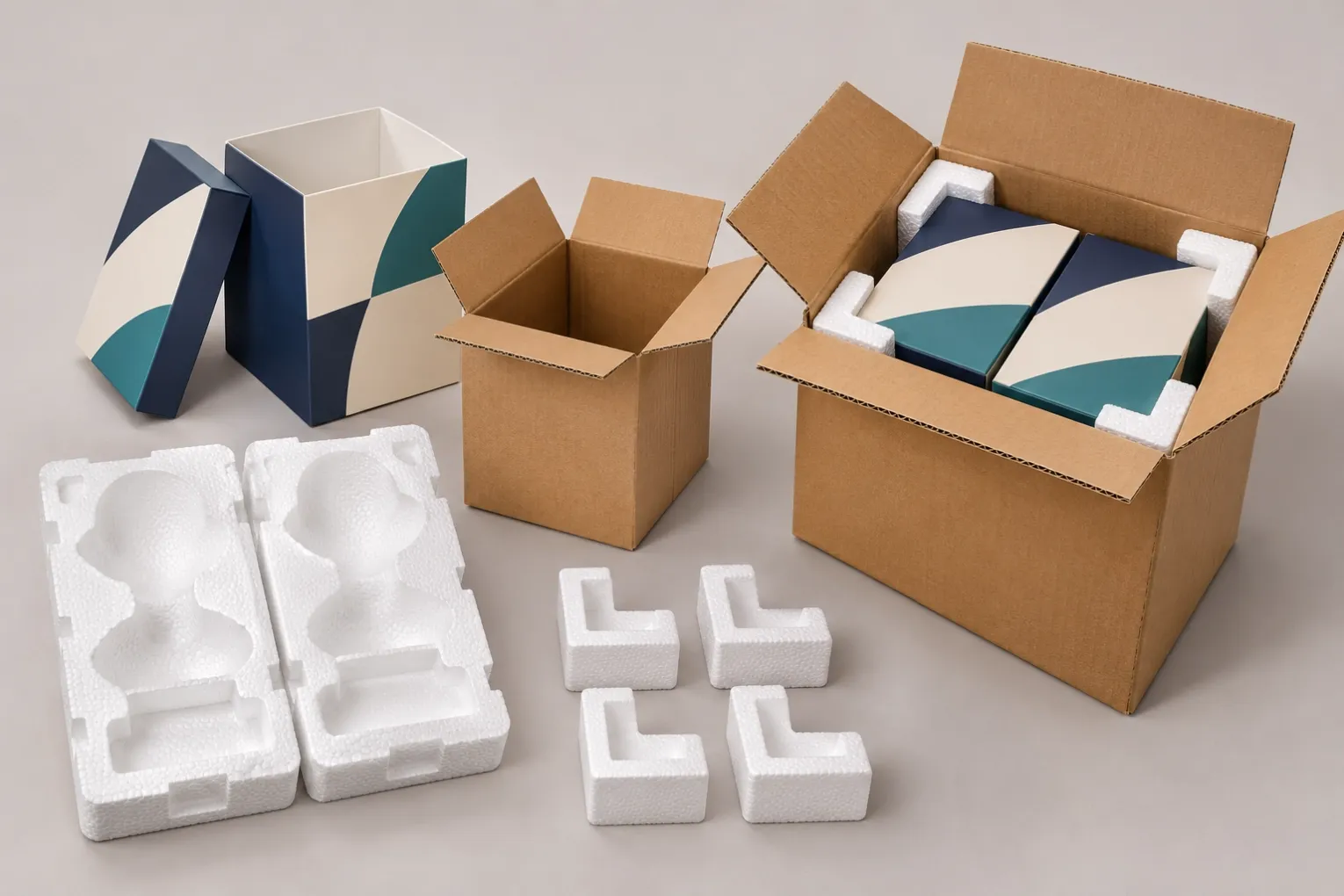
The accompanying photograph shows open cartons, shaped foam pieces and boxed products arranged together. It illustrates the relationship between outer packaging and inner protection. It does not document a passed drop test, a specific shipment or a customer approval.
Frequently Asked Questions
Can the packaging be approved from a dieline alone?
A dieline is useful for dimensions and print placement, but the product, protective parts and opening route still need a physical or clearly representative mockup review.
Should the figure ship fully assembled?
Not always. Decide from the product's fragile parts, owner experience, packing repeatability and the actual configuration. The important point is to define the supplied condition before the package is locked.
Does a snug cavity guarantee safe transport?
No. Fit is one packaging decision. Material behavior, contact surfaces, restraint, orientation and any required transport evaluation must be considered separately.