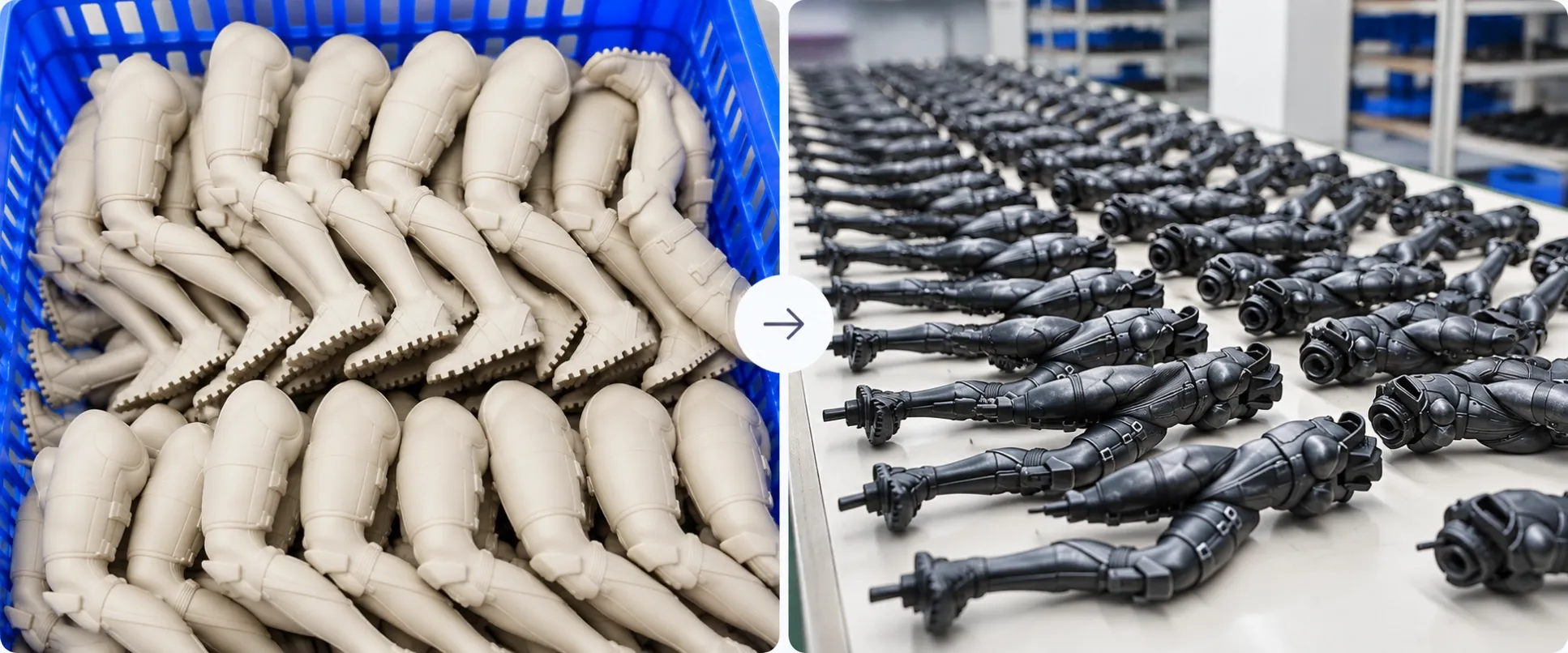
When Does a Mixed-Material Collectible Need an Interface Review?
Resin, PVC, fabric, metal and electronics behave differently at their connection points. Learn when an interface review is needed before production is locked.

A mixed-material collectible can look correct in separate samples and still fail at the connection between them. Resin may be rigid, fabric may move, metal may add weight and electronics may need protected access. The interface between materials deserves its own review before production is locked.
Map the connection points
List every place where materials meet: a fabric costume over a body, a metal prop fixed to a resin hand, a PVC part attached to a statue or a light module inside a base. Mark whether the connection is structural, visual, functional or temporary during assembly.
Review movement and load
A joint that looks acceptable when still may shift when the product is lifted, rotated or packed. Confirm which component carries the load and where movement is allowed. Do not assume that an adhesive or hidden pin will solve an interface that was never designed for access and alignment.
Protect the visual transition
The boundary between materials should be reviewed for gap, color, texture and scale. A small mismatch can become obvious when a glossy resin part meets a matte fabric or brushed metal surface. Use an assembled reference so the team judges the transition in the same context as the customer.
Plan access for assembly and service
If a battery, LED module, screw or connector must be reached, make the access route part of the interface decision. A clean exterior is not enough if the assembly sequence requires damaging a finished surface or forcing a fragile part.
Approve the interface separately
Record the approved fit, orientation, visible gap and allowable movement. If the materials or supplier changes, repeat the interface review rather than assuming the previous result transfers automatically.
Mixed-material products reward early coordination. A focused interface review protects the design intent while giving engineering, assembly and QC a shared answer about what “fit” means.
FAQ
Is an interface review needed for every material change?
Review any connection that affects fit, load, appearance, movement or access.
Can a hidden joint be ignored?
No. Hidden joints still influence stability, assembly order and long-term handling.
When should the review happen?
Before tooling and finishing are fully committed, using representative parts and the intended assembly condition.