Oct 27, 2026
What Should Be Checked on Metallic-Looking Collectible Finishes?
Check metallic-looking collectible finishes for reflection consistency, visible surface defects, retained detail, handling marks and the effect of final coatings.
Check metallic-looking collectible finishes for consistent reflection, unwanted surface marks, retained sculpted detail and compatibility with the intended final coating and handling sequence. Review the surface from several angles before deciding that a bright patch is a defect: a reflection can move with the light, while a scratch or uneven coating remains attached to the same area.
A gold or silver appearance does not identify the underlying process. Use the agreed finish reference and production specification rather than assuming that every metallic-looking part is metal or that every reflective surface should look like a mirror.
Separate a moving highlight from a fixed surface issue
Compare the sample and reference under the same lighting, with similar orientation. Rotate the part slowly and observe whether the apparent patch travels across the curved surface or stays in one location. Large folds, cheeks and rounded armor naturally produce different reflections from flat panels.
Then examine any persistent mark at closer range. A fixed line may be a scratch, an underlying seam or a deliberate sculpted feature. Identify which before asking for rework. Record the location and viewing angle so another person can reproduce the observation instead of guessing from a tightly cropped photograph.
Judge reflection character as well as color
Two parts can look similarly gold in a photograph while reading differently beside each other. One may have a softer metallic appearance; another may reflect sharper highlights. Compare the intended sheen and texture, not just the apparent color on a screen.
Do not automatically reject differences between differently shaped surfaces. First orient comparable areas similarly and check against the physical reference. The goal is the approved appearance, not identical brightness at every point. Our process provides the broader development and sample-review context for agreeing on that reference.
Keep fine detail visible through the finish
Look at engraved lines, hair, fabric texture and small ornaments after the intended finish steps. A reflective appearance can draw attention to softened detail or a repaired area that was less obvious earlier. More coating is not necessarily a solution if it obscures the sculpt.
Check the relationship between textured and smooth areas. They may intentionally scatter light differently. A review should distinguish that design choice from unwanted roughness, visible particles or an inconsistent surface. Avoid describing everything as “not shiny enough”; identify what is wrong and where.
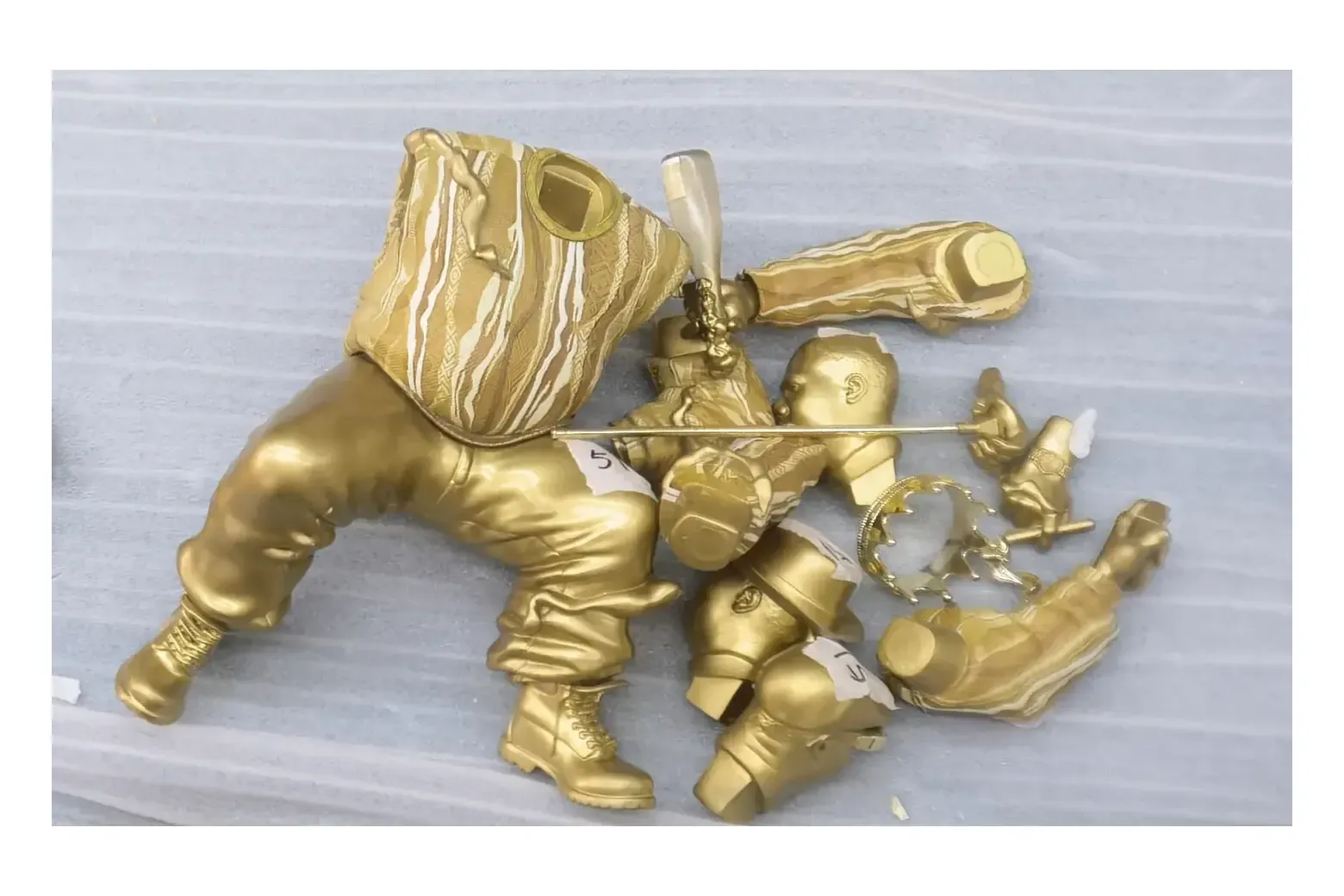
The accompanying real photograph shows grouped gold-colored components on protective foam before assembly. It makes several curved and textured surfaces visible, but it does not establish the coating method, completion of every finish step or any inspection result.
Review the surface at its intended final stage
Ask whether the reference and current part have received the same coating sequence. An intermediate metallic layer and a completed finish may not have the same appearance. Review representative areas after any specified protective coating rather than approving one stage and assuming the next will be visually neutral.
Treat local touch-up as a finish decision
An isolated repair can differ in sheen or texture even when its color seems close. Review the proposed repair under the same conditions as the original surface. Do not polish, rub or apply a cleaner to a disputed mark without a compatible, agreed method; that can change the surface being judged.
Protect the reviewed finish through assembly
Identify safe handling areas and supports before parts are joined. Keep hard tools and loose accessories away from visible surfaces, and check that locating or adhesive areas meet the assembly specification. Finishing a part successfully does not remove the need to protect it during the next operation.
Recheck accessible surfaces after handling and assembly, especially where a tool, fixture or adjacent component could leave a mark. If an issue appears, separate it from the approved stock and decide whether it requires cleaning, repair or replacement. Do not hide an unresolved surface concern inside the assembled object.
For relevant collectible formats, see our products. To discuss a metallic-looking finish, contact us with the intended appearance, physical reference and areas where handling or assembly may affect the result.
FAQs
Does a bright spot mean the metallic finish is uneven?
Not necessarily. Change the viewing angle and compare with the reference. A moving highlight is different from a fixed patch, scratch or surface irregularity.
Can a photograph confirm the exact metallic color and sheen?
A photograph helps locate an issue, but lighting, exposure and screens affect the appearance. Use consistent images and a physical reference when color or sheen remains disputed.
Should a metallic-looking finish always be mirror-smooth?
No. The target may be soft, textured, aged or highly reflective. Judge the surface against the agreed finish, not a general preference for greater shine.