When Should a Cosmetic Variation in a Collectible Be Reworked?
Define collectible cosmetic defect acceptance with observable references, viewing conditions and clear rework decisions instead of relying on subjective “looks good” judgments.
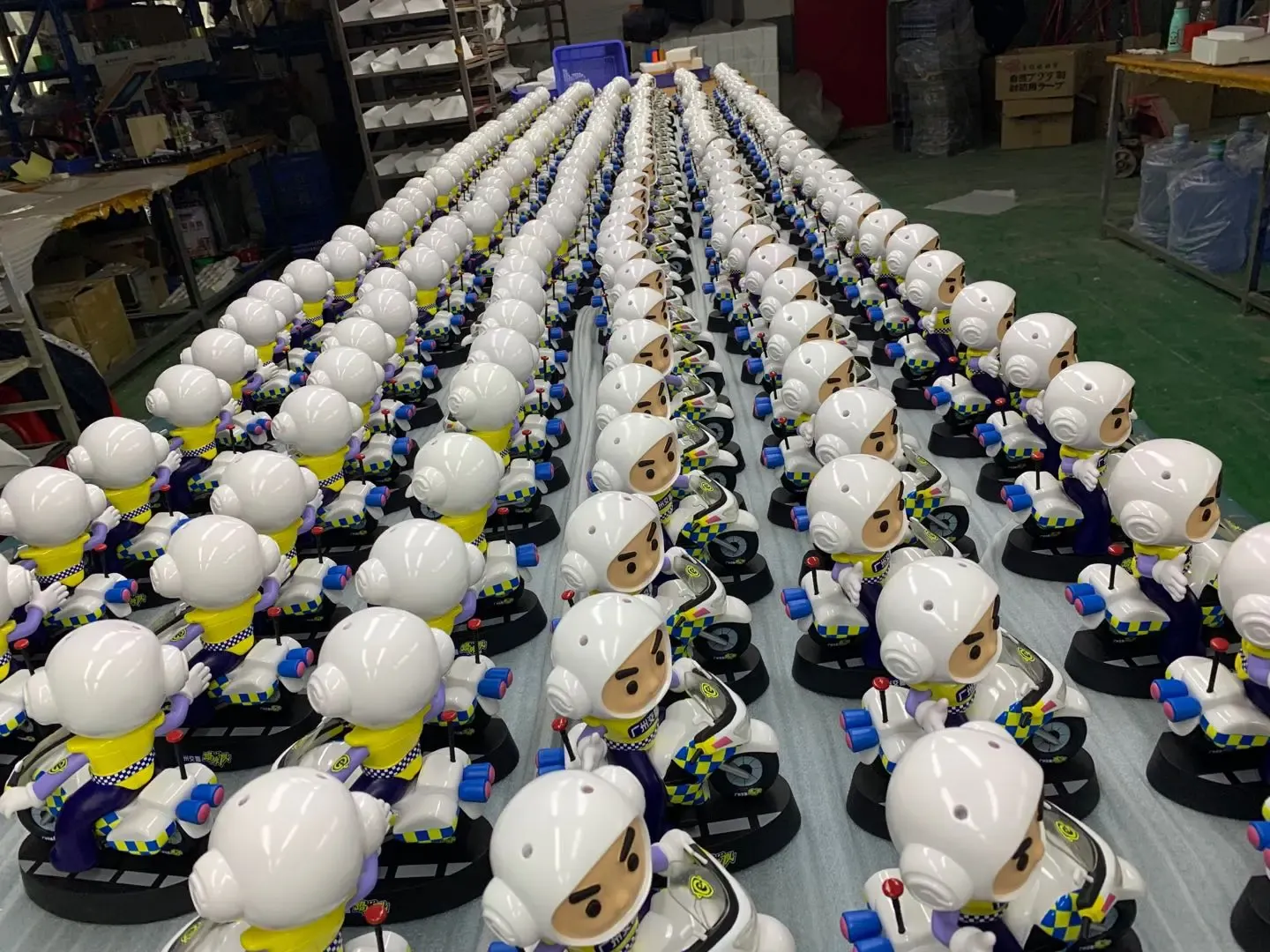
Rows of finished collectibles on a production work surface. This photograph illustrates batch production; it does not identify rejected pieces or establish an inspection result.
A cosmetic variation should be reworked when it violates an agreed appearance requirement or falls outside a boundary the brand has defined as acceptable. Not every visible difference in a hand-finished collectible is automatically a defect, and not every defect requires the same response.
The difficult part is not noticing that two pieces look slightly different. The difficult part is deciding whether that difference matters.
That decision becomes much more consistent when the brand and manufacturer define the visual standard before mass production instead of asking QC to make subjective judgments at the end.
An approved sample is a reference, not a complete acceptance system
An approved sample is essential because it shows the intended overall result. But a single physical sample cannot describe every possible production variation.
A hand-painted surface can vary slightly in spray transition, weathering placement or texture while still preserving the approved character. Other details—such as eye direction, a clean paint boundary, a logo position or a visible assembly alignment—may have much less room to vary.
If the only instruction is “match the approved sample,” different people can still make different decisions about the same production piece.
The sample therefore needs supporting acceptance guidance for the details that matter most.
Write appearance criteria in observable terms
A useful visual standard describes what an inspector can actually see.
Instead of:
- paint should look good;
- color should be close;
- weathering should be natural;
- assembly should be clean;
the standard should identify the feature being judged and the condition that matters.
Depending on the project, that may include:
- paint boundary position;
- overspray on a neighboring surface;
- visible bare material;
- eye direction or symmetry;
- placement of printed or applied graphics;
- surface contamination;
- gloss or matte relationship between adjacent areas;
- obvious scratches, dents or paint loss;
- gap or alignment at an assembled interface;
- whether a variation is visible on the intended display face.
ASTM’s guidance on workmanship, finish and appearance makes the same broader point: appearance requirements should be spelled out clearly, including which minor surface imperfections are not considered cause for rejection. The exact criteria for a collectible still need to come from the product itself.
Separate intentional variation from unwanted variation
Some collectible finishes are supposed to look controlled but not mechanically identical.
Weathering, dry brushing, washes, skin-tone transitions and hand-applied texture can contain small differences. Trying to force every brush mark into exactly the same position can be unrealistic and can even make the finish look less natural.
Other features need tighter control because small shifts change the character or product quality more obviously.
The acceptance plan should therefore distinguish between:
- controlled artistic variation — differences allowed within the intended look;
- cosmetic nonconformity — a visible condition outside the approved appearance;
- functional or structural nonconformity — a problem affecting fit, movement, stability, function or safe use.
Those categories should be defined for the actual project. A generic defect list cannot know which details carry the character or which surfaces are normally hidden.
Visibility and location matter
A small mark on a hidden underside is not always equivalent to the same mark across a portrait, chest emblem or polished display surface.
This is not an argument for ignoring hidden defects. It is an argument for defining severity in context.
A visual acceptance standard can consider:
- where the condition appears;
- whether it is visible in the normal display position;
- whether it changes the intended character or finish;
- whether it affects a focal feature;
- whether it can worsen during handling;
- whether rework is likely to improve or damage the part.
That last point matters. Rework itself has risk.
Rework is not automatically the best answer
When a cosmetic issue is found, the possible decisions may include acceptance, touch-up, part replacement, sorting, hold-for-review or full rework.
Repeated paint correction can create its own problems: extra film build, mismatched sheen, rough edges, visible repair marks or damage to nearby finished areas. A part that has already been assembled may also be riskier to repair than one caught earlier in the process.
This is one reason in-line inspection matters. A problem found before the next operation is often easier to assess and correct than the same problem discovered after final assembly.
The correct rework decision therefore depends on both the cosmetic issue and the production stage.
Use limit references for the difficult decisions
For subjective features, one of the most practical tools is a boundary reference: a photograph or physical example showing the edge of what is acceptable.
That is especially useful for conditions such as:
- weathering intensity;
- soft spray transitions;
- minor print position variation;
- acceptable texture;
- small cosmetic marks;
- surface sheen differences.
The purpose is not to create dozens of perfect samples. It is to give inspectors and the brand a shared answer to the difficult middle cases.
The viewing condition should also be sensible and repeatable. If a feature is being approved under one lighting condition and inspected under another, disagreements become much more likely.
AQL does not define what a cosmetic defect is
Acceptance sampling can help decide how a production lot is inspected, but the sampling method cannot decide what the product standard should be.
ISO 2859-1:2026 provides AQL-indexed sampling schemes for inspection by attributes. That is useful only after the team knows what will be counted as conforming or nonconforming.
In other words:
first define the defect; then define how it will be inspected.
Using an AQL value without a clear visual defect standard simply makes an unclear decision statistically organized.
It is also important not to confuse an individual defect with proof that an entire production process has failed. Collector discussions often use “QC issue” to describe any problem found on one figure. From a manufacturing point of view, a single defective piece and a broader process-control problem are not the same conclusion.
A consumer complaint is evidence that a particular problem was experienced. It does not, by itself, establish the prevalence or root cause across the production run.
What should be agreed before production?
Before mass production begins, a collectible brand and manufacturer should have a practical appearance reference set that answers:
- Which approved sample or master is the primary reference?
- Which visual features are critical to the character?
- Which hand-finished areas allow controlled variation?
- What conditions are clearly unacceptable?
- Are there boundary examples for subjective features?
- What viewing conditions are appropriate?
- Which defects require immediate escalation?
- Which issues can be reworked safely, and at what production stage?
- When should a part be replaced rather than repeatedly touched up?
- What inspection or sampling plan applies after the criteria are defined?
This does not eliminate judgment. Collectibles are visual products, and some judgment will always remain.
The goal is to make that judgment shared and repeatable.
Consistency starts with a decision, not an inspection
Final QC cannot create a standard that the project never defined.
The strongest acceptance system starts earlier: the approved appearance is translated into observable criteria, intentional variation is separated from unwanted variation, and difficult boundary cases have references.
Then production teams can make better decisions about whether a piece should pass, be corrected, be replaced or be escalated.
For a collectible brand, that is more useful than asking for “perfect consistency.” It defines which differences matter—and gives the factory a realistic way to control them.
FAQ
Is every visible difference between two collectibles a defect?
No. Hand-finished products can contain controlled variation. A defect is a condition that falls outside the agreed appearance, functional or structural requirements for the project.
Can AQL replace an approved sample or visual standard?
No. AQL is part of an acceptance-sampling approach. The team still needs to define what counts as conforming or nonconforming before sampling results can be interpreted.
Should the factory decide cosmetic tolerances on its own?
Preferably not. The brand and manufacturer should agree on the appearance references and acceptable boundaries together, especially for character-critical, hand-finished or highly visible features.