Blind Box Economics: When a Random Model Makes Sense — and When It Doesn't
A blind box is a series decision, not a single-figure decision. When random makes sense, what it costs in production, and when to sell openly instead.
A blind box asks the buyer to pay before knowing exactly what they will get. That sounds like a strange way to sell a product — until you look at what the buyer is actually buying. They are not buying one figure. They are buying a chance at a set, a reason to come back for another box, and the small thrill of opening something sealed.
That is why the economics of a blind box cannot be judged figure by figure. A single figure lives or dies on its design. A blind-box series lives or dies on the logic of the whole series: how many designs there are, how they are produced side by side, how the surprise is protected in packaging, and whether the buyer trusts that the random draw is fair.
The market context is strong. Verified Market Research puts the blind-box market at $16.96 billion in 2024, growing to $38.4 billion by 2032, at a compound annual growth rate of 9.49%. On the demand side, eBay's 2025 Collected Report recorded blind-box sales up 470% versus 2024 — a sales signal, not a market total. The question for a brand is whether the format works for your product, at your quantity, with your production plan.
Why Blind Box Works as a Series, Not as a Single Figure
A blind box only makes sense when the product is a series. The buyer needs a reason to buy a second box, and then a third. That reason is the set: a group of designs that belong together, where owning one makes the others more desirable, not less.
Three mechanics drive that repeat purchase. First, set completion — collectors want the full group, and each box brings them closer or gives them a duplicate to trade. Second, variety within a consistent style — the designs differ enough to be worth collecting, but share a scale, a finish, and a world, so the set looks coherent on a shelf. Third, the chase — one rarer design gives the whole set a centre of gravity and a reason to keep opening boxes.
None of these mechanics exists for a single figure. A one-off statue or a single hero figure has no set to complete and no duplicate to trade. Randomising it would only take away the buyer's choice without giving anything back. The format earns its place when the product is conceived as a series from the start — the characters, the scale, and the price planned together, and the blind box as the way the series is sold, not an afterthought applied to a finished design.
How Many Designs a Blind Box Series Actually Needs
There is no universal number of designs for a blind-box series, and any article that gives one without knowing your budget, your mould plan, and your sales window is guessing. What a buyer can decide in advance is the trade-off that the number creates.
Too few designs, and the series runs out of reasons to buy. Collectors complete the set quickly, duplicates pile up, and repeat sales stop. Too many designs, and the production workload multiplies: every design is, in effect, a small production run of its own — its own mould set, its own paint steps, its own assembly sequence, its own quality checks.
The right count sits where those two pressures balance: enough designs that the set feels worth collecting, and few enough that each design can be made properly, checked properly, and packed correctly. That balance depends on how the series will be sold, how long it will stay on sale, and how much mould and paint work the budget can carry.
The same thinking applies to the rarer design — the chase or hidden figure, if the series has one. Its rarity has to be decided before tooling, because it changes the production split across designs: the moulds, the paint runs, and the packing quantities all follow from it. Adding a hidden design after the series is planned is not a small change; it is a change to the whole production schedule.
What Randomness Costs in Production
Randomness is free for the buyer and expensive for the factory. The buyer opens a box and finds a surprise. The factory has to make sure that surprise is the right surprise, in the right box, in the right condition, every time.
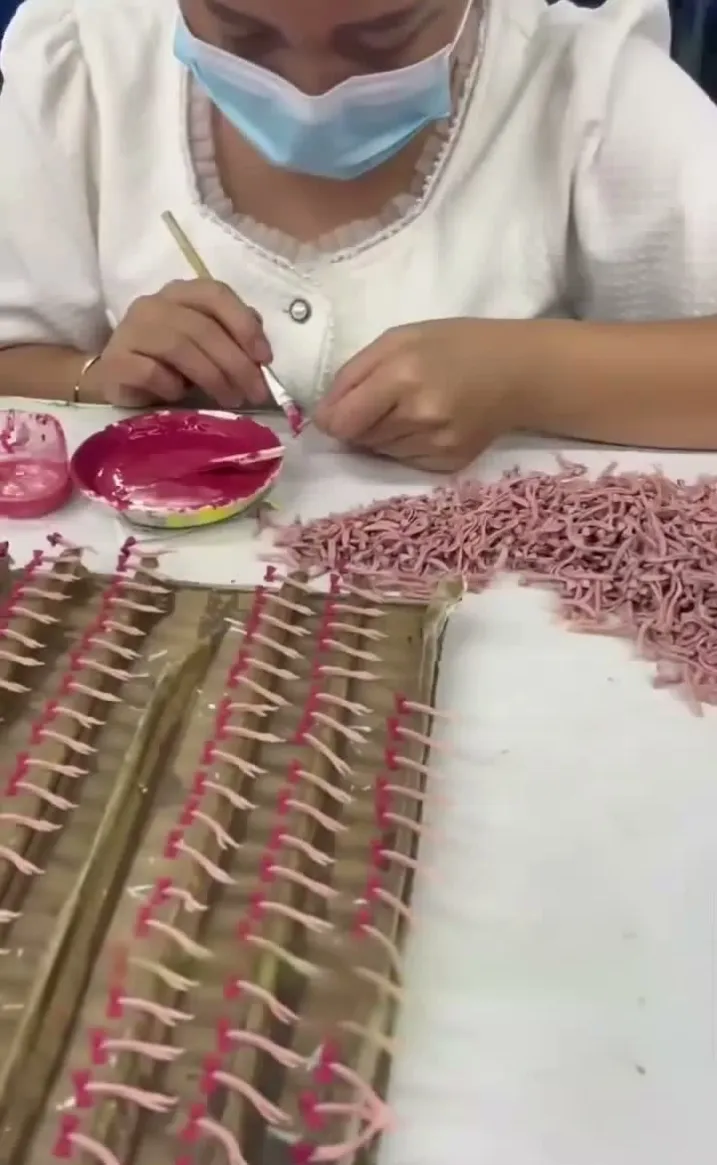
The first cost is parallel production. A blind-box series means several designs moving through sculpting, moulding, painting, and assembly at the same time. Each design needs its own quality standard, and a problem in one design cannot be allowed to hold up the whole series — or, worse, to be hidden inside it. Quality control has to be done design by design, not series by series.
The second cost is sorting and packing. Sealed boxes have to contain the intended mix of designs, and the mix has to stay honest across the whole run. That needs a packing plan that tracks quantities per design, and a check that the count is right before the boxes are sealed. If one design runs short, the series is short — not just one figure.
The third cost is spares and rework. A defect in one design means remaking that design, not the whole series — but only if the designs are produced and stored separately until packing. And because blind-box figures are usually produced in volume, the material choice matters: PVC injection moulding suits larger runs of small figures, while resin casting suits smaller, high-detail pieces. At Mancheng, PVC/ABS figures are one of our four product categories — resin statues and busts, PVC/ABS figures, 1/6 scale figures, and prop replicas and electronic collectibles — and PVC injection moulding is partner-managed, so the volume question is part of the first production conversation, not an afterthought.
When Blind Box Is the Wrong Choice
Blind boxes are a format, not a default. There are products it actively harms.
A high-priced statue is the clearest case. When a buyer pays a premium price, they are paying for a specific piece — a specific pose, a specific character, a specific finish. Taking away their choice does not add excitement; it adds risk. The buyer who wanted one statue and received another is not a repeat customer. They are a return.
A licensed portrait is another. When the value of the product is the likeness of a particular character, randomising the character removes the reason to buy. The same applies to a single hero piece, a commemorative edition, or any product whose story is "this one, exactly this one."
The format is also wrong when the production volume cannot support several moulds. A blind-box series needs enough quantity per design to justify tooling for each of them. If the total order only just covers one mould, splitting it across several designs leaves each one too thin to make well.
The test is simple: would the buyer be happy with any design in the series? If the honest answer is "only one of them," the product should be sold openly, with the buyer choosing. Blind box works when every design in the box is a design the buyer would be glad to own.
How to Plan Packaging So the Surprise Stays a Surprise
The packaging of a blind box has a job that ordinary packaging does not: it has to keep a secret. If the buyer can tell which design is inside — by seeing through the box, by feeling its shape, or by weighing it — the format fails before the box is opened.
That means the box must be fully opaque, with no window and no thin panel that shows a colour or a silhouette. The figure inside should sit in a sealed inner bag or wrap, so that even if the box is opened slightly, the design is not visible. The box itself must be strong enough not to dent or deform in a way that hints at the contents, and the inner fit must hold the figure still, so shaking the box tells the buyer nothing.
Weight is the quiet leak. If one design is noticeably heavier than the others — a larger figure, a heavier base, a metal part — buyers will learn to weigh boxes. Keeping the weight consistent across designs, or keeping the difference small enough not to be felt, is part of the packaging plan, not a detail to discover after production. The same applies to size: the box should be the same for every design in the series.
Protection matters as much as secrecy. A blind box that arrives crushed has lost both its surprise and its value, and the buyer has no way to choose a better box — every box is sealed. That is why the packaging should be tested as part of the product, not after it. At Mancheng, our packaging is drop-tested, and the box, the inner fit, and the outer carton are planned together with the figure, so that the surprise survives the journey from the factory to the collector's shelf. For more on treating packaging as part of the product, see our earlier article on collector packaging.
What to Decide Before You Brief a Factory
A blind-box brief is longer than a single-figure brief, because more has to be settled before production starts. Six decisions should be made before the first conversation with a factory:
- Series positioning. Who is the series for, and what holds the designs together — a character family, a theme, a style?
- Design count. How many designs, in what range, and what the budget allows for moulds and paint work across all of them.
- Chase logic. Whether the series has a rarer design, how rare it is, and how that changes the production split.
- Material and size. PVC/ABS for volume runs, or resin for smaller, high-detail pieces — and one consistent size across the series, so the boxes, the weight, and the shelf presence all match.
- Packaging specification. Opaque box, sealed inner bag, consistent weight, drop-tested protection — written down, not assumed.
- Quantity per design and quality standard. How many of each design, how quality is checked design by design, and what happens when one design needs rework.
Bring reference images, the intended size, and the series story to that first conversation. A factory can quote a series properly only when it can see all the designs at once — the moulds, the paint steps, the packing plan, and the schedule depend on the whole set, not on one figure. Mancheng Collectibles is an authorized OEM manufacturer in Dalingshan, Dongguan, with 10+ years of experience producing custom collectibles for brands, studios, and creators — under our clients' authorization, with their designs and IP remaining theirs.
Sources: Verified Market Research, blind-box market $16.96B in 2024 → $38.4B by 2032, CAGR 9.49%; eBay 2025 Collected Report, blind-box sales +470% vs 2024 (a sales signal, not a market total).
Related: W03 — Should Collector Packaging Be Treated as Part of the Product?
Planning a blind-box series — or deciding whether random is right for your product? Request a quote